










What's Happening?
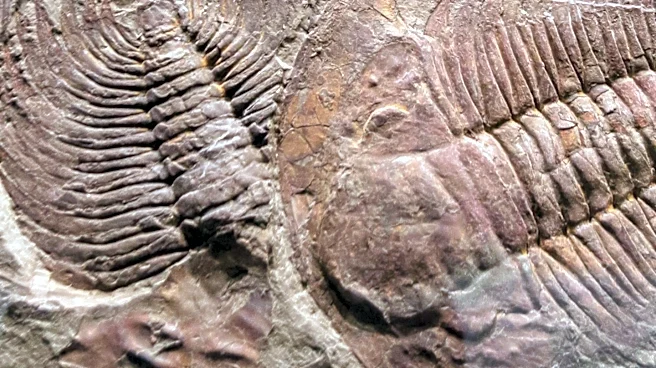
Recent research into Cambrian fossil records has uncovered significant insights into the evolution of foundational animal characteristics. The study focused on Spriggina floundersi fossils from South Australia, which date back to the Ediacaran period,
preceding the Cambrian explosion. These fossils exhibit evidence of right-handedness, a trait suggesting complex behaviors were present before the Cambrian period. This discovery challenges previous assumptions that such traits only developed during the Cambrian explosion, a time known for the rapid diversification of animal life. The findings indicate that many modern animal characteristics, such as bilateral symmetry and behavioral handedness, may have evolved earlier than previously thought.
Why It's Important?
The implications of these findings are profound for understanding the evolutionary timeline of animal life on Earth. By establishing that complex behaviors and traits existed before the Cambrian explosion, this research suggests that the diversification of life during the Cambrian was built upon pre-existing foundations. This could reshape scientific perspectives on how early life evolved and adapted, providing a new framework for studying the origins of complex life forms. The study also highlights the importance of the Ediacaran period in the evolutionary history, potentially leading to a reevaluation of how scientists approach the study of early life forms.
What's Next?
Future research will likely focus on further exploring the Ediacaran period to uncover more about the evolutionary developments that preceded the Cambrian explosion. Scientists may conduct additional fossil excavations and employ advanced technologies to analyze existing specimens in greater detail. This could lead to new discoveries about the behaviors and physical characteristics of early life forms, offering deeper insights into the evolutionary processes that shaped the diversity of life on Earth today.
Beyond the Headlines
The discovery of behavioral handedness in Spriggina floundersi not only provides evidence of early complex behaviors but also suggests the presence of a relatively advanced nervous system in these ancient organisms. This finding could prompt a reevaluation of the cognitive capabilities of early life forms and their ability to interact with their environment. Additionally, the study raises questions about the genetic and developmental pathways that led to such traits, potentially influencing future research in evolutionary biology and genetics.