







What's Happening?
The Amazon Basin is facing increasing threats from climate change, according to a report launched by UNU-CRIS (United Nations University Institute on Comparative Regional Integration Studies). The report, titled 'Assessment of Regional Variations in Disaster
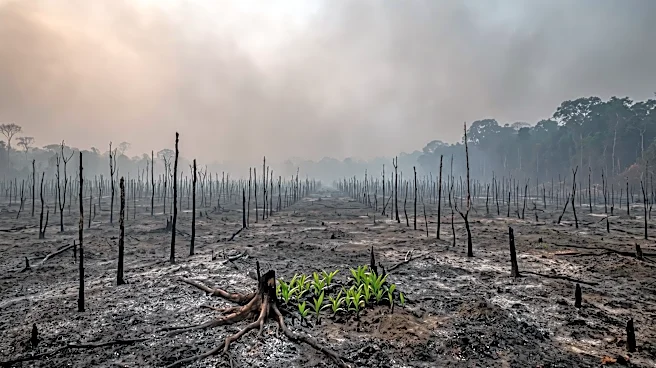
Risk Management Strategies across the Amazon River Basin,' identifies floods, droughts, and fire hazards as escalating risks within the region. This research was prepared by a team of experts including María Jazmín Chávez Álvarez, Nidhi Nagabhatla, Daniela Chamorro Moreno, Sil Katrien Maslov-Lescrauwaet, Andrea Ribeiro Hoffmann, and Philippe De Lombaerde. The findings underscore the urgent need for effective disaster risk management strategies to address the growing environmental challenges in this critical global ecosystem.
Why It's Important?
The UNU-CRIS report is crucial because it highlights the severe and multifaceted impacts of climate change on the Amazon Basin, a region vital for global biodiversity and climate regulation. Escalating risks such as floods, droughts, and fires threaten not only the unique ecosystems and countless species within the Amazon but also the livelihoods and safety of the millions of people, including indigenous communities, who reside there. The report's focus on regional variations in disaster risk management strategies suggests that a one-size-fits-all approach is insufficient, emphasizing the need for tailored, localized solutions. Effective management of these risks is essential to prevent further environmental degradation, mitigate humanitarian crises, and protect the Amazon's capacity to absorb carbon dioxide, which is critical for combating global warming. The findings can inform policy decisions, resource allocation, and international cooperation efforts aimed at building resilience in the face of a changing climate.
What's Next?
Following the release of the UNU-CRIS report, it is anticipated that policymakers, regional organizations, and international bodies will use its findings to re-evaluate and strengthen disaster risk management strategies across the Amazon Basin. This may involve increased investment in early warning systems, climate-resilient infrastructure, and sustainable land management practices. There is likely to be a push for enhanced collaboration among the Amazonian countries to develop coordinated responses to transboundary climate threats. The report could also stimulate further research into the specific vulnerabilities of different regions within the basin and the effectiveness of various adaptation and mitigation measures. Additionally, there may be calls for greater international financial and technical support to assist Amazonian nations in implementing robust climate action plans and protecting their natural resources.
Beyond the Headlines
The UNU-CRIS report on climate risks in the Amazon Basin delves deeper than immediate disaster preparedness, touching upon the profound ethical and social justice implications of climate change. Indigenous communities, who have historically been stewards of the Amazon, are often disproportionately affected by environmental disasters, despite contributing minimally to the causes of climate change. The report implicitly calls for a re-evaluation of development models in the region, advocating for approaches that prioritize ecological integrity and the rights of local populations. The escalating fire hazards, for instance, are often linked to deforestation and agricultural expansion, highlighting the complex interplay between economic activities and environmental degradation. Addressing these risks requires not only scientific and technological solutions but also fundamental shifts in governance, land use policies, and global consumption patterns. The Amazon's fate, as underscored by this report, is inextricably linked to global efforts to achieve environmental justice and sustainable development.