



What's Happening?
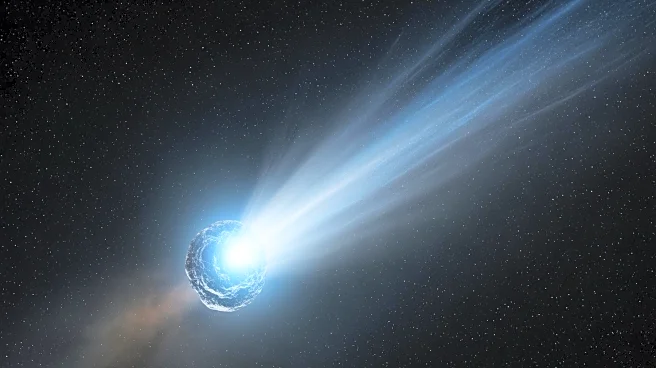
The Hubble Space Telescope has captured detailed images of the interstellar comet 3I/ATLAS as it makes its final pass through the solar system. The comet, discovered in late June, will make its closest approach to Earth on December 19, 2025. Hubble's
observations in November revealed the comet's nucleus and coma, showing it as a bright white glow against a background of streaked stars. The comet is estimated to be between 0.3 and 5.6 kilometers across and is traveling through the inner solar system at approximately 130,000 mph. Despite the challenges posed by satellite constellations, Hubble continues to provide valuable data on this unique interstellar object.
Why It's Important?
The observation of 3I/ATLAS is significant as it is only the third confirmed interstellar object to pass through our solar system. The data collected by Hubble and other observatories provide insights into the composition and behavior of objects from outside our solar system, which can enhance our understanding of the universe. The presence of prebiotic molecules in the comet's atmosphere suggests that such interstellar objects could play a role in distributing life's building blocks across the galaxy. This event underscores the importance of space telescopes in advancing our knowledge of cosmic phenomena.
What's Next?
As 3I/ATLAS approaches its closest point to Earth, astronomers will continue to monitor its trajectory and activity. The comet's flyby presents a rare opportunity for scientists to study an interstellar object in detail, potentially leading to new discoveries about the origins of comets and the materials they carry. Observations from various spacecraft and telescopes will be analyzed to refine models of cometary behavior and composition. The data collected will contribute to future missions aimed at intercepting and studying interstellar objects.