







What's Happening?
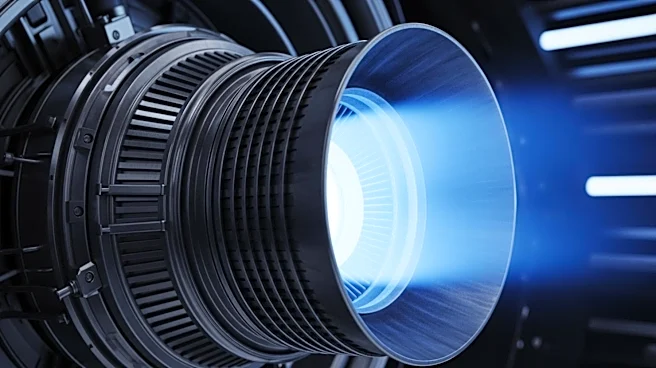
Mega Engine Technology, a commercial startup based in Xi'an, China, has announced a significant achievement in rocket engine development. The company has successfully accumulated 1,000 seconds of test time on a high-pressure oxygen-rich staged-combustion
kerolox engine, named Chi. This engine is notable for its rapid startup, stable operation, and intact hardware post-testing. The engine's performance places it in the category of engines suitable for reusable medium-lift launchers, with a sea-level thrust throttleable between 35 and 75 tons, rising to 87 tons in vacuum. The development of such an engine typically takes a decade, but Mega Engine has achieved this in under two years, suggesting a rapid advancement in their engineering capabilities.
Why It's Important?
The development of the Chi engine represents a significant advancement in China's commercial space sector, potentially reducing reliance on state-run propulsion technologies. This achievement could enhance the capabilities of Chinese commercial launchers, providing them with access to high-performance engines without state intervention. The success of Mega Engine Technology highlights the effectiveness of China's civil-military fusion policy, which accelerates the transfer of state-developed technologies to the private sector. This approach contrasts with the U.S. model, where commercial applications are often developed before military adaptations, potentially delaying technological advancements. The Chi engine's success could position Mega Engine as a key player in the global space industry, offering competitive propulsion solutions.
What's Next?
Mega Engine Technology plans to unveil a second engine, Yan, later in 2026. This 200-ton-class closed-cycle kerolox engine is intended for heavy-lift applications, potentially expanding China's commercial space capabilities. If successful, Yan would mark a significant milestone, providing a domestically produced, reusable, high-performance engine outside the state monopoly. The development of these engines aligns with China's ambitions to support megaconstellation programs, which require increased launch capabilities. The success of Mega Engine's technology could lead to increased competition in the global space industry, challenging established players and potentially leading to more cost-effective launch solutions.
Beyond the Headlines
The rapid development of the Chi engine underscores the strategic importance of civil-military fusion in China's industrial policy. This approach facilitates the swift transition of state-developed technologies to the commercial sector, enhancing China's competitive edge in the global space industry. The success of Mega Engine Technology could inspire similar initiatives in other sectors, promoting innovation and technological advancement. However, the reliance on state-trained engineers and technologies raises questions about the independence and sustainability of such commercial ventures. The long-term impact of this model on global competition and technological innovation remains to be seen.