
What's Happening?
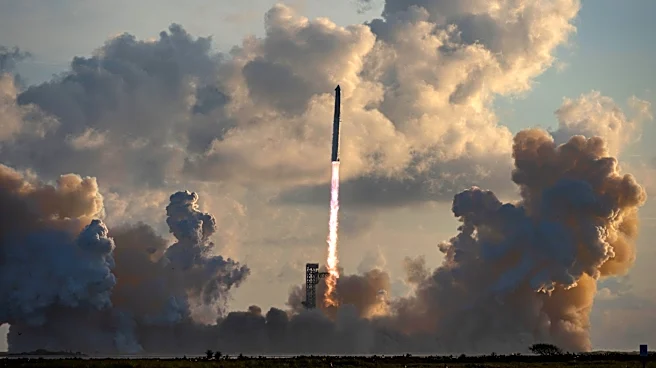
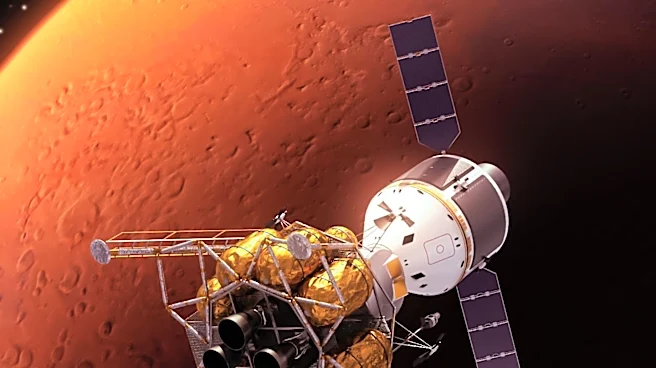
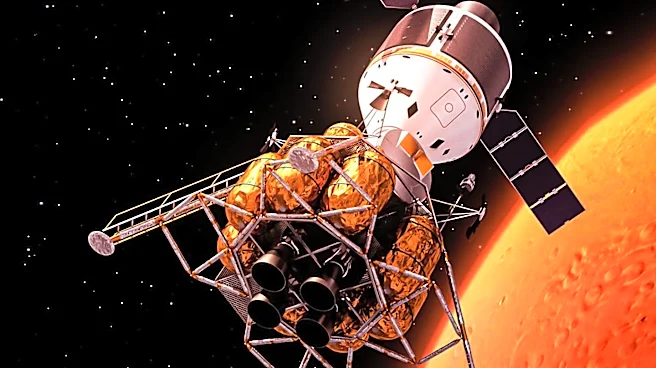
The twin spacecraft of NASA's ESCAPADE Mission, named Blue and Gold, have successfully completed their Trans-Mars Injection (TMI). Designed and built by Rocket Lab for NASA and the University of California
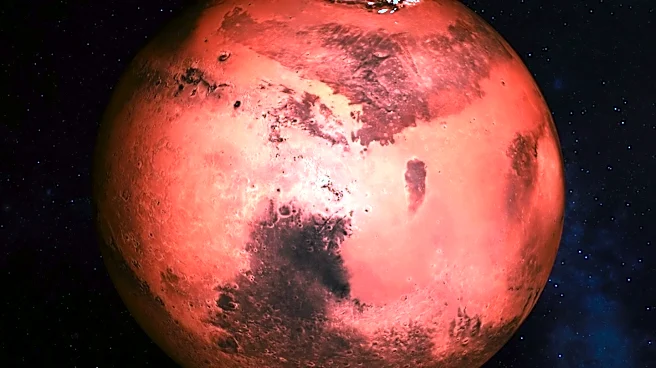
Berkeley's Space Science Laboratory, these spacecraft executed powered Earth gravity assists before firing their main engines for 9.5 minutes. This maneuver propelled them past Earth at over 10 kilometers per second, initiating their interplanetary cruise phase towards Mars. The spacecraft are scheduled to arrive at the Red Planet in September 2027, where their primary mission will be to study the Martian atmosphere. A Trans-Mars Injection is a critical propulsive maneuver that places a spacecraft on a trajectory, or Mars transfer orbit, to reach Mars with the lowest possible energy requirements, typically utilizing transfer windows that open every two years.
Why It's Important?
The successful Trans-Mars Injection of the ESCAPADE mission's twin spacecraft marks a significant milestone in planetary science and space exploration. This mission is crucial for enhancing our understanding of the Martian atmosphere, particularly its magnetosphere, which plays a vital role in how Mars interacts with solar wind and how it may have lost its water over billions of years. Data collected by Blue and Gold will provide valuable insights into atmospheric escape processes, which are fundamental to understanding the evolution of planetary atmospheres and the potential for life beyond Earth. Furthermore, the mission demonstrates the growing capabilities of commercial partners like Rocket Lab in contributing to complex interplanetary missions, potentially lowering costs and increasing the frequency of deep-space exploration. The collaboration between NASA, UC Berkeley, and private industry highlights a model for future space endeavors, fostering innovation and accelerating scientific discovery.
What's Next?
Following the successful Trans-Mars Injection, the Blue and Gold spacecraft will now enter an interplanetary cruise phase, traveling towards Mars. Their arrival is anticipated in September 2027. Upon reaching Mars, the spacecraft will begin their scientific operations, focusing on studying the Martian atmosphere and its magnetosphere. The data collected will be analyzed by researchers from UC Berkeley's Space Science Laboratory, NASA Goddard Space Flight Center, Embry Riddle Aeronautical University, and other partners. This research is expected to contribute significantly to our understanding of Mars's past and present habitability. The success of this mission could also pave the way for more frequent and ambitious small-scale interplanetary missions, leveraging the efficiency and innovation of commercial space companies. The insights gained will be critical for planning future human and robotic missions to Mars, including resource utilization and long-term presence.
Beyond the Headlines
The ESCAPADE mission's success in reaching Trans-Mars Injection underscores a broader strategic shift in space exploration: the increasing reliance on smaller, more agile spacecraft and commercial partnerships for deep-space scientific endeavors. This approach allows for more frequent missions and the ability to take on higher-risk, higher-reward scientific objectives. The study of Mars's atmosphere is not just about understanding a single planet; it's about gaining fundamental knowledge applicable to exoplanets and the conditions necessary for life. The mission's focus on atmospheric escape mechanisms could inform our search for habitable worlds beyond our solar system. Moreover, the engineering feat of achieving TMI with twin spacecraft, designed and built by a commercial entity, highlights the democratization of space access and the potential for a more diverse range of scientific investigations in the coming decades. This could lead to a future where interplanetary missions are more common, less costly, and more responsive to emerging scientific questions.