



What's Happening?
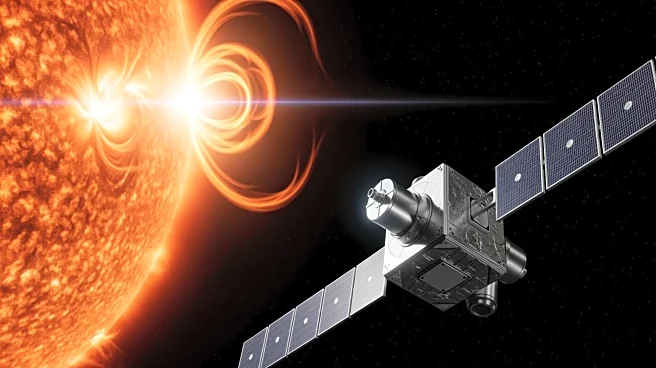
Astronomers using the James Webb Space Telescope (JWST) have discovered compelling evidence of an atmosphere around the rocky exoplanet TOI-561 b. This finding challenges the prevailing belief that small planets orbiting very close to their stars cannot
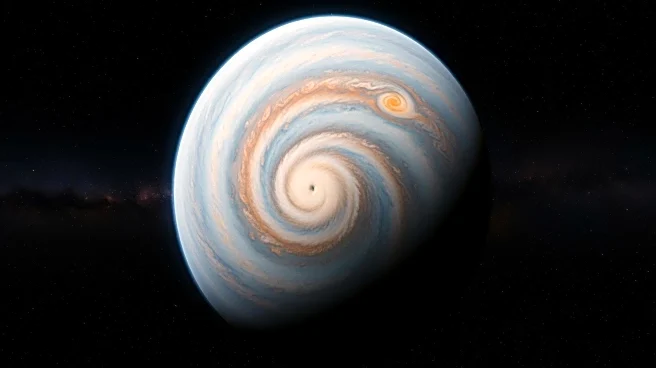
sustain atmospheres. TOI-561 b, an ultra-hot super-Earth, orbits a 10-billion-year-old star located about 280 light-years from Earth. The planet completes a full orbit in under 11 hours, placing it in a class of ultra-short-period super-Earths. Despite the intense stellar radiation expected to strip away any atmosphere, observations from NASA's TESS space telescope revealed that TOI-561 b has an unusually low density for a purely rocky world. Using the JWST's NIRSpec instrument, scientists measured the planet's dayside temperature, finding it significantly cooler than expected if it lacked an atmosphere. This suggests the presence of a thick, volatile-rich atmosphere that could be maintained by a balance between the planet's molten surface and its atmosphere.
Why It's Important?
The discovery of an atmosphere on TOI-561 b has significant implications for our understanding of planetary formation and atmospheric retention in extreme environments. It challenges existing models that predict atmospheres cannot survive on planets so close to their stars. This finding could lead to a reevaluation of the conditions under which atmospheres can exist, potentially expanding the criteria for habitability in exoplanetary systems. The presence of an atmosphere on such a hot planet suggests complex interactions between the planet's surface and its atmospheric gases, which could inform future studies on planetary geology and atmospheric science. This research also highlights the capabilities of the JWST in probing the atmospheres of distant worlds, paving the way for more detailed studies of exoplanets and their potential to support life.
What's Next?
Future research will likely focus on further characterizing the atmosphere of TOI-561 b and understanding the mechanisms that allow it to persist in such a harsh environment. Scientists may conduct additional observations using the JWST and other telescopes to gather more data on the planet's atmospheric composition and dynamics. These studies could provide insights into the geological activity of TOI-561 b and similar exoplanets, offering clues about their formation and evolution. The findings may also prompt the development of new models to predict atmospheric retention on other ultra-hot super-Earths, potentially identifying more candidates for detailed atmospheric study.
Beyond the Headlines
The discovery of an atmosphere on TOI-561 b raises intriguing questions about the potential for life in extreme environments. While the planet itself is unlikely to support life as we know it, understanding how atmospheres can exist in such conditions could inform the search for life on other planets. The study of TOI-561 b's atmosphere may also reveal new insights into the chemical processes that occur on rocky planets, contributing to our broader understanding of planetary science. Additionally, this research underscores the importance of advanced telescopes like the JWST in expanding our knowledge of the universe and challenging existing scientific paradigms.