









What's Happening?
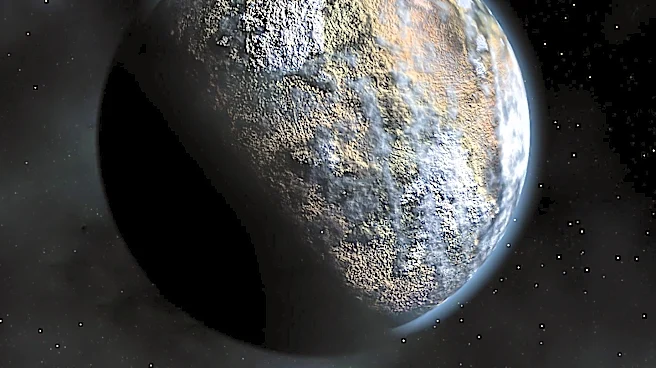
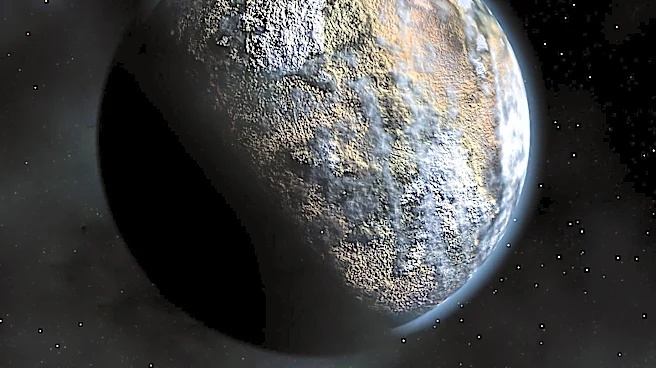
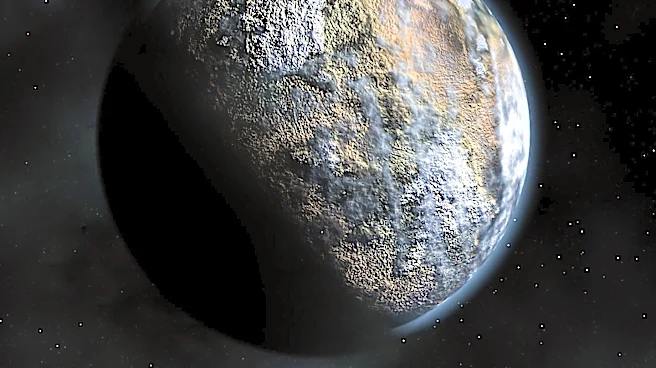
For the first time, astronomers have identified an atmosphere on a rocky, temperate exoplanet, LHS 1140b, which orbits an M dwarf star about 50 light years from Earth. This discovery, made by Collin Cherubim and his team at Harvard University, was achieved
using observations from the Las Campanas Observatory in Chile. The presence of helium atoms in an excited state in the planet's light spectrum suggests an atmospheric outflow, marking LHS 1140b as a potential 'helium world.' This type of exoplanet, characterized by a thick atmosphere overlaying a rocky surface, has been theorized but not previously confirmed. The planet's location in the habitable zone of its star, where conditions might allow for liquid water, adds to its potential for supporting life.
Why It's Important?
The detection of an atmosphere on LHS 1140b is significant as it challenges previous assumptions that planets orbiting M dwarf stars might not retain atmospheres. This finding opens new avenues for the search for extraterrestrial life, as the planet's atmospheric conditions could support life forms, albeit in unconventional ways. The presence of an atmosphere in the habitable zone makes LHS 1140b a prime candidate for further study in the quest to find life beyond Earth. This discovery could influence future astronomical research priorities and funding, as scientists aim to understand the composition and dynamics of this atmosphere, potentially using data from the James Webb Space Telescope.
What's Next?
Further observations are planned to better understand the atmospheric composition of LHS 1140b. The variability in the helium signature, observed in 2024 but not in 2025, suggests dynamic atmospheric processes that require more study. Researchers aim to determine whether the helium outflow is a consistent feature or subject to change due to stellar activity or other factors. These investigations will help clarify the planet's habitability potential and guide future missions targeting similar exoplanets.
Beyond the Headlines
The discovery of LHS 1140b's atmosphere could redefine our understanding of planetary atmospheres and their evolution, particularly around M dwarf stars. This could have implications for the classification of exoplanets and the criteria used to assess their habitability. Additionally, the study of helium worlds might offer insights into the atmospheric processes of gas giants and icy moons within our solar system, providing a broader context for comparative planetology.