





What's Happening?
A theoretical study, published in Physical Review D, explores the possibility that five-dimensional black holes could explain the existence of dark matter and certain high-energy neutrinos. The research, involving scientists like Luis Anchordoqui of Lehman
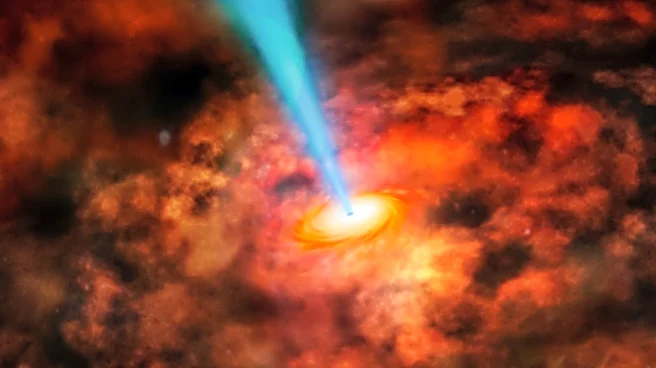
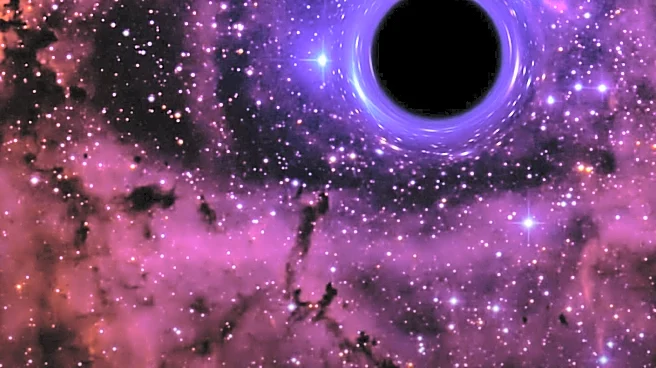
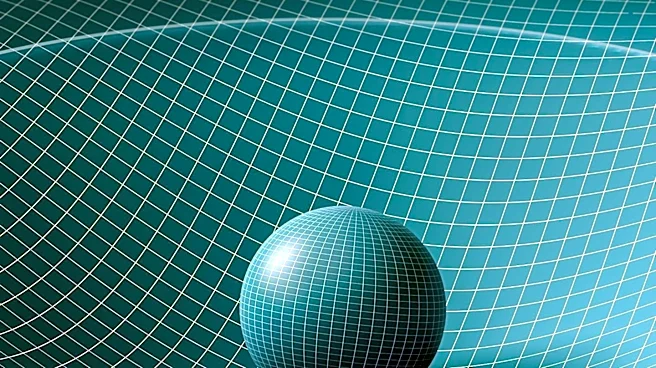
College and the CUNY Graduate Center, and Alek Bedroya of Princeton University, posits a 'dark dimension' scenario where space-time includes an additional spatial direction of micron-scale size. In this model, gravity can extend into this extra dimension, causing primordial black holes (PBHs) to behave differently than conventional four-dimensional black holes. These five-dimensional PBHs would be larger, colder, and longer-lived, potentially surviving for trillions of years, and could account for some or all of the matter identified as dark matter. The study also suggests a connection between the evaporation of these five-dimensional PBHs and the exceptionally energetic neutrino event KM3-230213A, observed by the KM3NeT/ARCA detector.
Why It's Important?
This theoretical proposal is significant as it offers a novel explanation for two major cosmic mysteries: dark matter and the origin of high-energy neutrinos. Dark matter's existence is inferred from its gravitational effects, but its nature remains unknown. By linking it to five-dimensional primordial black holes, the study provides a concrete, albeit theoretical, candidate. The proposed connection to high-energy neutrinos could also help explain observed cosmic ray events that defy current understanding. If validated, this theory would profoundly impact particle physics and cosmology, potentially leading to new experimental approaches to detect dark matter or understand neutrino sources. It also highlights the ongoing effort to reconcile quantum gravity with observed cosmic phenomena, pushing the boundaries of theoretical physics.
What's Next?
The next steps involve further theoretical development and, crucially, experimental verification. While the study provides a theoretical framework, the existence of the 'dark dimension' and five-dimensional black holes remains unconfirmed. Future observations, particularly from projects like 'POEMMA-Balloon with Radio' (PBR) planned for spring 2027, aim to investigate extremely energetic neutrinos. Such measurements could help distinguish predictions about particle energies and accompanying signals, potentially offering indirect evidence for or against the proposed mechanisms. However, even if neutrino signals align with the theory, it would not automatically prove a hidden dimension. The scientific community will continue to refine models and seek direct or indirect evidence for these exotic phenomena.
Beyond the Headlines
This research delves into the fundamental structure of the universe, exploring concepts like extra dimensions and primordial black holes that challenge our everyday perception of reality. The idea of a 'dark dimension' is a testament to the creative and abstract nature of theoretical physics, where mathematical models are used to explore possibilities beyond current observational limits. It also underscores the interconnectedness of different areas of physics, from quantum gravity to particle physics and cosmology, in the quest to understand the universe. The pursuit of such theories, even if unconfirmed, pushes technological boundaries and inspires new experimental designs, ultimately advancing scientific knowledge and our understanding of the cosmos.