






What's Happening?
Hanwha Defense USA has been awarded a significant contract by the U.S. Army to supply prototype 155mm self-propelled howitzers for its Mobile Tactical Cannon (MTC) program. The agreement, valued at up to $262.9 million, initially covers six K9 Mobile Howitzers,
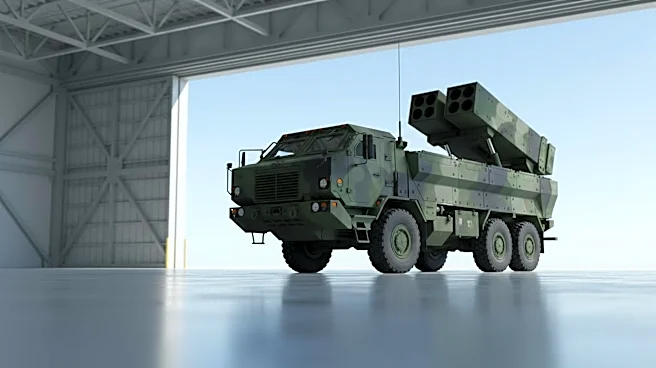
with an option for an additional 12 systems. This marks Hanwha's first major direct contract with the U.S. Army and provides the company a crucial entry point into the Army's artillery modernization efforts. The Army is seeking a mobile, protected 155mm artillery system to replace some of its M777 towed howitzers, aiming to enhance mobility and survivability for maneuver formations. Hanwha's K9 Mobile Howitzer, or K9MH, is a wheeled variant of its established K9 family of self-propelled howitzers. The company proposed this system for the MTC competition after the Army shifted its focus from developing new artillery systems to acquiring mature, readily producible systems. The prototype solicitation includes manufacturing, network integration, ammunition compatibility, safety, and characterization testing, followed by soldier evaluation.
Why It's Important?
This contract is strategically important for Hanwha Defense USA as it establishes a significant presence in the U.S. defense market and positions the company for potential larger production efforts. The U.S. Army's MTC program is anticipated to lead to a substantial production contract, potentially covering as many as 500 systems starting around fiscal year 2028. The program emphasizes domestic production capacity, requiring competitors to establish U.S.-based manufacturing capabilities to support increased output during wartime mobilization. Hanwha has already begun addressing this requirement by establishing an integration and test facility in Opelika, Alabama, and plans to invest over $2 million in the U.S. artillery supply chain during the initial phase of its localization efforts. This move could create jobs and stimulate economic activity in the U.S. defense sector. For the U.S. Army, the selection of the K9MH represents a shift towards evaluating proven systems, aiming to accelerate the modernization of its artillery fleet after the cancellation of the Extended Range Cannon Artillery (ERCA) program in 2024.
What's Next?
The immediate next step involves the delivery and testing of the six prototype K9 Mobile Howitzers. These systems will undergo rigorous Army testing and soldier evaluation to assess their performance, reliability, ammunition compatibility, and suitability for operations with maneuver brigades. The results of these evaluations will be crucial in determining whether the U.S. Army proceeds with a larger procurement. Hanwha's continued investment in its U.S. manufacturing capabilities will also be a key factor, as the program prioritizes domestic production. The MTC program is expected to culminate in a final production decision, potentially leading to a contract for hundreds of systems. The success of these prototypes could significantly influence future U.S. Army procurement strategies for artillery systems and potentially open doors for Hanwha in other U.S. defense programs. The company will likely continue to engage with U.S. defense officials and stakeholders to demonstrate the capabilities and benefits of the K9MH.
Beyond the Headlines
The selection of Hanwha Defense USA, a South Korean company, for a critical U.S. Army modernization program highlights a broader trend of international collaboration in defense procurement. This partnership could foster deeper technological exchange and interoperability between the U.S. and its allies. The emphasis on establishing U.S.-based manufacturing capacity, even for foreign-designed systems, underscores the importance of domestic industrial base resilience and job creation within the defense sector. This approach allows the U.S. to leverage advanced foreign technologies while ensuring economic benefits and supply chain security. Furthermore, the Army's shift towards evaluating mature, off-the-shelf systems rather than developing entirely new ones reflects a pragmatic approach to modernization, aiming to field capabilities more quickly and cost-effectively. This could set a precedent for future defense acquisitions, prioritizing proven solutions over potentially lengthy and expensive development cycles. The success of the K9MH in U.S. service could also enhance its global market appeal, benefiting Hanwha's international sales.