



What's Happening?
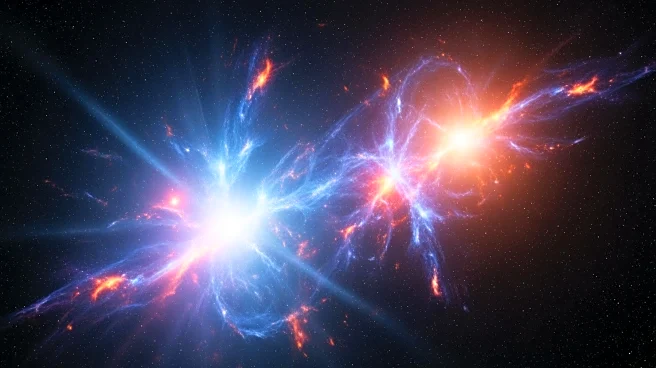
NASA's Hubble Space Telescope has revisited the Crab Nebula, a supernova remnant, to capture its expansion over the past 25 years. This observation provides a detailed look at the aftermath of a supernova explosion that was first recorded by astronomers
in 1054. The Crab Nebula, located 6,500 light-years away in the constellation Taurus, is powered by a pulsar at its center. The new images reveal intricate filamentary structures and significant outward movement of these filaments at a speed of 3.4 million miles per hour. The Hubble's longevity and resolution make it uniquely capable of capturing these changes, offering insights into the nebula's 3D structure and the dynamics of its expansion.
Why It's Important?
The Hubble's observations of the Crab Nebula are significant for understanding the long-term evolution of supernova remnants. By comparing the new images with those from 1999, astronomers can study changes in temperature, density, and chemical composition of the nebula's gas. This research enhances our knowledge of how such remnants expand and evolve, contributing to the broader understanding of stellar life cycles and the dynamics of the universe. The data from Hubble, combined with observations from other telescopes like the James Webb Space Telescope, will provide a comprehensive view of the Crab Nebula's ongoing transformation, aiding in the study of cosmic phenomena.
What's Next?
Future research will involve comparing Hubble's optical data with multiwavelength observations from other telescopes to create a more complete picture of the Crab Nebula's expansion. This will help scientists understand the interactions between the pulsar's magnetic field and the nebula's material, as well as the role of synchrotron radiation in its expansion. Continued observations will also contribute to the study of other supernova remnants, offering insights into the processes that shape the universe over millennia.
Beyond the Headlines
The Hubble's ability to capture detailed changes in the Crab Nebula over decades highlights the importance of long-term astronomical observations. This research not only advances scientific knowledge but also underscores the value of international cooperation in space exploration, as the Hubble is a joint project between NASA and the European Space Agency. The findings may also inspire future missions and technological advancements in space telescopes, ensuring continued exploration of the cosmos.