
What's Happening?
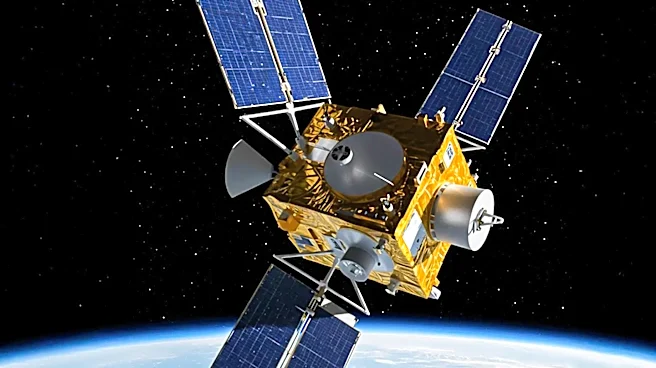
Launched in 1976, LAGEOS-1 (LAser GEOdynamic Satellite) is a unique scientific satellite that remains in service despite lacking any instrumentation, electronics, power supply, or propulsion. Weighing
just under 407 kg and spherical in shape, it resembles a disco ball due to its surface being covered with corner cube retroreflectors. These retroreflectors are designed to reflect incident light directly back to its source. Ground stations on Earth fire short laser pulses at LAGEOS-1 and measure the time it takes for the light to return, a technique known as time-of-flight ranging. Because LAGEOS-1 maintains an exceptionally stable orbit, it serves as a reliable reference point for precisely measuring minute changes in Earth's characteristics, including its size, shape, and rotation. Data from LAGEOS-1 and its successor, LAGEOS-2 (launched in 1992), has also been utilized in tests of general relativity. Its design and orbit were specifically chosen to minimize atmospheric drag and other disturbances, ensuring its longevity.
Why It's Important?
LAGEOS-1's long-term operation highlights the effectiveness of passive satellite design for specific scientific objectives. Its stable orbit and precise reflective properties make it an invaluable tool for geodynamics, allowing scientists to track continental drift, measure Earth's gravitational field, and monitor changes in sea level with high accuracy. This data is crucial for understanding fundamental geological processes and for climate change research. The satellite's longevity, expected to be millions of years, demonstrates a remarkable engineering achievement in creating a maintenance-free, durable space asset. Furthermore, its contribution to testing general relativity underscores its significance beyond Earth sciences, providing empirical data for fundamental physics. The LAGEOS mission exemplifies how simple, robust designs can yield profound and long-lasting scientific returns, offering a cost-effective approach to certain types of space-based research.
What's Next?
LAGEOS-1 and LAGEOS-2 are expected to continue orbiting Earth for millions of years, providing a continuous, stable reference for geodetic measurements. As technology for ground-based laser ranging improves, the precision of the data collected from these satellites may also increase, allowing for even more refined measurements of Earth's dynamic processes. The data collected will remain vital for long-term studies of Earth's crustal movements, polar motion, and gravitational field variations. Future generations of scientists will continue to utilize this passive satellite system for geodetic research and potentially for new applications not yet conceived. The enduring presence of LAGEOS also serves as a testament to the foresight of its designers, demonstrating the value of creating space assets with extreme durability and minimal operational requirements.
Beyond the Headlines
Beyond its scientific utility, LAGEOS-1 carries a unique message to the future: two identical plaques prepared by Dr. Carl Sagan. This inclusion imbues the satellite with a cultural and philosophical dimension, transforming it from a mere scientific instrument into a time capsule or a message in a bottle cast into the cosmic ocean. It reflects humanity's enduring curiosity and desire to communicate across vast stretches of time, contemplating the possibility of future civilizations encountering our artifacts. This aspect of LAGEOS-1 prompts reflection on our place in the universe and the legacy we leave behind. It also highlights the interdisciplinary nature of space exploration, where scientific endeavors can intersect with art, philosophy, and the human imagination, creating objects that serve multiple purposes across different scales of time and understanding.