




What's Happening?
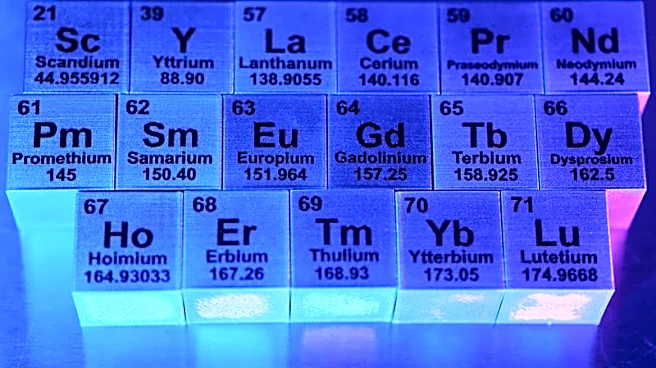
A recent study published in Nature Geoscience has revealed that the thickness of Earth's lithosphere plays a crucial role in the formation and distribution of CO2-rich magmas, which are significant sources of rare earth elements (REE). These elements are vital
for modern technologies such as electric vehicles and wind turbines. The research utilized geochemical data from over 9,000 igneous rock samples and seismic imaging to establish a link between lithospheric thickness and magma chemistry. The study found that thicker lithospheres favor the formation of CO2-rich silicate magmas, which are associated with REE deposits. This discovery provides a new method for predicting the occurrence of REE deposits, which are essential for renewable energy technologies and the transition to low-carbon economies.
Why It's Important?
The findings of this study are significant as they offer a new approach to locating rare earth element deposits, which are critical for the development of renewable energy technologies. As the demand for these minerals increases, understanding their formation and distribution becomes crucial for ensuring a stable supply. The study's insights could lead to more efficient exploration efforts, reducing reliance on existing supply chains dominated by countries like China. This could have substantial economic implications, potentially leading to increased investment in mining and exploration activities in regions with favorable lithospheric conditions.
What's Next?
Future research will focus on older geological systems that host many of the world's largest rare earth deposits. This could further refine predictions of critical mineral occurrences across various tectonic settings and geological periods. Additionally, exploration efforts may intensify in regions identified as having favorable lithospheric conditions for REE deposits. This could lead to new mining projects and investments, potentially altering the global supply chain dynamics for these essential minerals.
Beyond the Headlines
The study also enhances the understanding of Earth's deep carbon cycle by linking lithospheric thickness to magma generation and carbon enrichment. This connection between deep-mantle processes and surface geology could have broader implications for understanding Earth's geological history and the formation of mineral resources. Moreover, the research highlights the importance of integrating geochemical and geophysical data to address complex geological questions, potentially influencing future studies in the field.