


What's Happening?
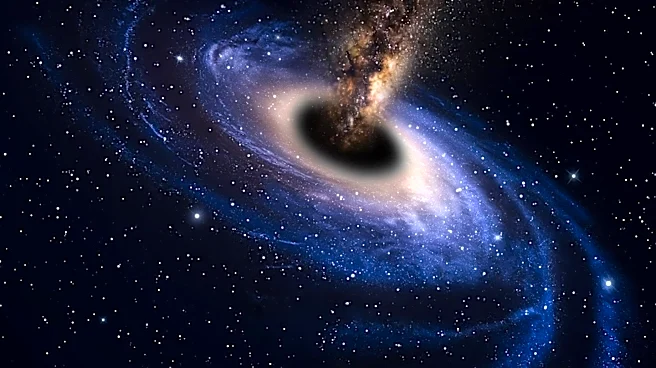
A UCLA-led study, published in AAS Journals, suggests that frequent stellar collisions in the early universe may explain the rapid formation of massive black holes. Researchers used models to demonstrate that in dense star clusters, stars could repeatedly
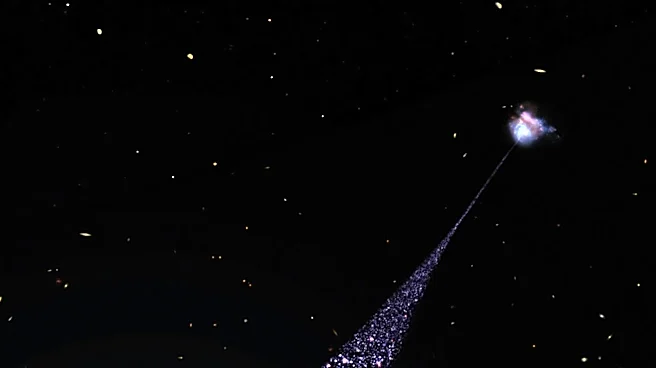
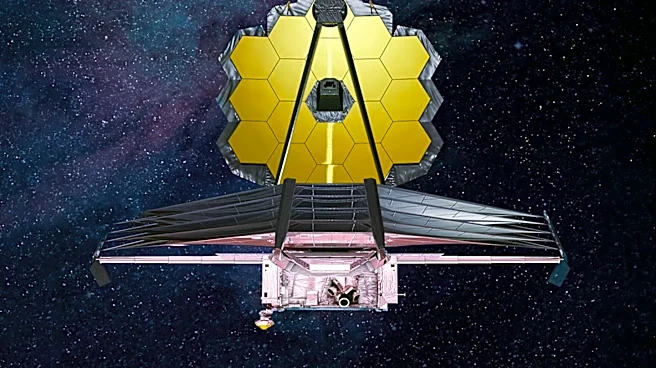
merge, forming exceptionally large stars. These colossal stars, with masses potentially equal to an entire cluster, would then collapse into massive black holes. This theory addresses the long-standing astronomical puzzle of how supermassive black holes appeared so quickly after the Big Bang, a phenomenon observed by the James Webb Space Telescope. Doctoral student Claire Williams, the corresponding author, noted that the simulations showed stars merging repeatedly to form a single gigantic star, which would then collapse into a massive black hole. The study also draws parallels between these early-universe conditions and the center of the Milky Way galaxy, which hosts a supermassive black hole within a dense star cluster.
Why It's Important?
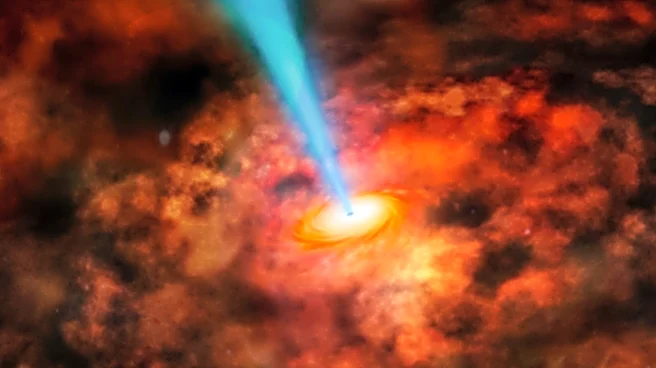
This research is crucial for advancing our understanding of cosmic evolution and the origins of the universe's most enigmatic objects. The rapid appearance of supermassive black holes in the early universe has challenged existing theories, which typically suggest a more gradual growth process. By proposing stellar collisions as a primary mechanism, the study offers a plausible pathway for the formation of 'seed' black holes that are significantly larger than those formed from the collapse of individual stars. This 'head start' could account for the observed massive black holes in the early cosmos. Furthermore, the study's connection to 'little red dots'—compact, reddish objects observed by the James Webb Space Telescope—suggests these could be dense stellar systems undergoing such collision-driven black hole formation, potentially unifying several astronomical observations under a single explanatory framework.
What's Next?
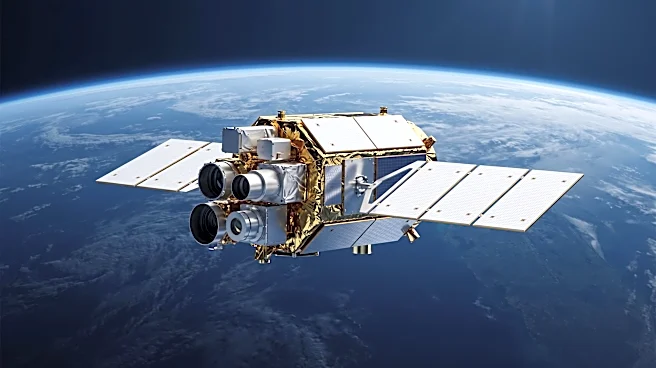
The proposed sequence of black hole formation through stellar collisions is based on models, necessitating further observational verification. Future research will likely focus on using advanced telescopes, such as the James Webb Space Telescope, to gather more detailed data on 'little red dots' and other early-universe phenomena. Astronomers will aim to identify direct evidence of repeated stellar mergers or the unique signatures of black holes formed through this process. The study provides a testable hypothesis, guiding future observational campaigns and theoretical refinements. If confirmed, this model could significantly alter our understanding of galactic evolution and the role of dense star clusters in shaping the universe. Additionally, researchers will continue to explore the implications for intermediate-mass black holes, which are larger than stellar-mass black holes but smaller than supermassive ones, as these environments could be their natural birthplace.
Beyond the Headlines
The study's implications extend beyond astrophysics, touching upon the fundamental laws governing matter and energy under extreme conditions. The concept of 'runaway stellar merging,' where a single star accumulates mass from an entire cluster, highlights the dynamic and often violent nature of the early universe. This research also underscores the power of computational modeling in astrophysics, allowing scientists to simulate conditions that are impossible to observe directly. The comparison to the Milky Way's galactic center provides a tangible, nearby example of a dense stellar environment, offering a window into processes that occurred billions of years ago. Ultimately, this work contributes to a broader scientific effort to piece together the cosmic narrative, from the Big Bang to the present day, revealing the intricate interplay between stars, clusters, and black holes in shaping the universe we inhabit.