


What's Happening?
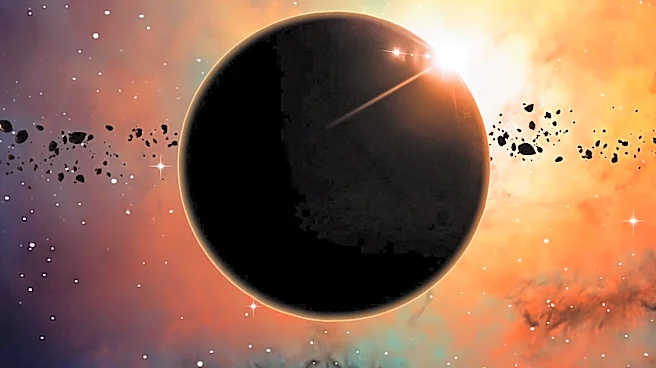
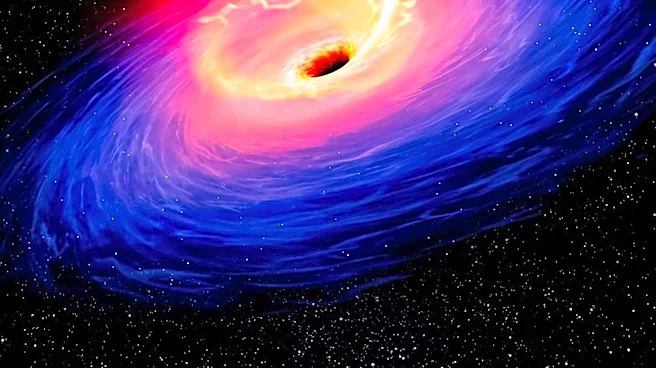
An international team of scientists, led by the University of Warwick, has observed the binary black hole system Swift J1727.8−1613 discharging material after consuming parts of its companion star. This discovery, detailed in the Monthly Notices of the Royal
Astronomical Society, challenges the traditional view of black holes as endless pits. Using the European Southern Observatory’s Very Large Telescope (VLT), astronomers monitored a 2023 eruption from Swift J1727.8−1613, witnessing winds and jets violently expelled from the black hole. Unlike typical single-image observations, the VLT allowed for a sequence of events to be tracked from consumption to eruption. Swift J1727.8−1613 is a smaller, less active black hole, approximately 10 times the mass of our Sun, orbiting a normal-sized star from which it strips material. The team noted that the eruptions continued even after the black hole had finished its 'meal,' suggesting a more complex process of matter processing and expulsion.
Why It's Important?
This observation is important because it provides new insights into the feeding mechanisms of black holes and their role in galactic evolution. The finding that black holes can 'barf' up leftover material after feeding suggests they function more like digestive systems rather than infinite voids. This challenges long-held assumptions about the efficiency of black hole consumption, indicating that a significant portion of consumed matter may not reach the black hole itself. This revised understanding could alter models of how binary star systems evolve within galaxies. If black holes are less efficient eaters, it means their impact on their immediate stellar environments and the broader galactic gas dynamics might be different than previously thought, influencing star formation rates and the distribution of matter in galaxies. The study also highlights the importance of continuous observation over time, rather than single snapshots, to fully comprehend dynamic astrophysical phenomena.
What's Next?
Researchers will continue to analyze the behavior of Swift J1727.8−1613 and similar black hole systems to further refine their understanding of black hole feeding and expulsion processes. The insights gained from this study will likely lead to the development of new theoretical models that incorporate these more complex digestive behaviors. Future observations with advanced telescopes will aim to identify more instances of black holes expelling material, helping to determine how common this phenomenon is across different types and sizes of black holes. This will contribute to a more comprehensive picture of black hole evolution and their interaction with surrounding matter, potentially leading to a re-evaluation of current theories on galactic development and the life cycles of stars in binary systems.
Beyond the Headlines
The discovery of black holes expelling matter after feeding has profound implications for our understanding of the universe's fundamental processes. It suggests that the interaction between black holes and their environment is far more dynamic and nuanced than previously conceived. This 'digestion' model could be a crucial piece in solving the puzzle of how supermassive black holes grow so rapidly in the early universe, as the expelled energy and matter could influence the surrounding gas and star formation in unexpected ways. Furthermore, this finding underscores the continuous evolution of scientific understanding, where new observational data can overturn established theories and open entirely new avenues of research. It highlights the universe's complexity and the ongoing quest to unravel its mysteries, pushing the boundaries of astrophysics and our place within the cosmos.