






What's Happening?
A U.S. Government Accountability Office (GAO) report, requested by Democratic Members of the House Committee on Homeland Security, has identified substantial deficiencies in the Department of Homeland Security's (DHS) Body-Worn Camera program for immigration
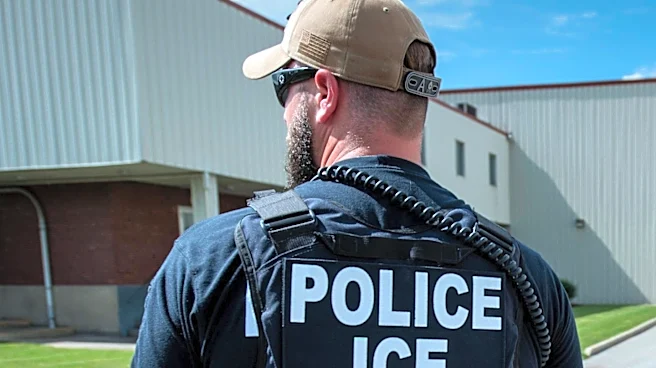
officers and agents. The report, titled 'Federal Law Enforcement: CBP and ICE Should Improve Body-Worn Camera Program Management,' found that despite a rapid deployment of body-worn cameras, both Customs and Border Protection (CBP) and Immigration and Customs Enforcement (ICE) lack updated program plans, results-oriented performance measures, and adequate controls to ensure consistent camera activation and usage. Specifically, the GAO noted that ICE's reliance on manual camera activation, unlike CBP, increases the risk of missing critical recordings. This issue was highlighted by Rep. Bennie G. Thompson (D-MS), Ranking Member of the Committee on Homeland Security, who cited an incident where Wilber Garces Perez was shot by an ICE agent in Austin, with critical recordings potentially missed. The report concludes that these gaps hinder DHS's ability to achieve the program's core objectives of transparency, accountability, and enhanced public trust.
Why It's Important?
The findings of this GAO report are critical for several reasons, primarily concerning public trust and accountability within federal law enforcement. The lack of proper controls and consistent activation in the DHS body camera program, particularly within ICE, undermines efforts to ensure transparency in interactions between agents and the public. This is especially pertinent given the rising number of shootings by DHS officers, with at least 25 people shot and six dead since January, including three American citizens, as noted by Rep. Lou Correa (D-CA). The report suggests that without automated activation and clear operational guidance, the program fails to provide the necessary oversight to address concerns about agent conduct and potential abuses of power. This situation could erode public confidence in federal immigration agencies and lead to increased calls for reform and stricter oversight mechanisms. The inability to reliably capture critical incidents on camera can also complicate investigations, making it harder to determine facts and hold individuals accountable for their actions, thereby impacting justice and civil liberties.
What's Next?
In response to the GAO report, Rep. Bennie G. Thompson (D-MS) announced his intention to introduce legislation aimed at closing the identified gaps and ensuring all DHS body-worn cameras have the recommended automatic activation. This legislative effort will likely seek to mandate automated controls for ICE cameras, similar to those used by CBP, and establish clear, transparent operational guidance for the program. The report's findings are expected to fuel further debate and scrutiny from Congress regarding DHS's accountability and its body camera program. Rep. Shri Thanedar (D-MI) emphasized the need for DHS to immediately reverse course, implement additional automatic activation controls, and issue transparent operations guidance. Stakeholders, including civil liberties groups and advocates for immigration reform, are likely to intensify their calls for immediate action and comprehensive reforms to ensure transparency and accountability within DHS operations. The proposed legislation will be a key focus, potentially leading to significant changes in how federal immigration agents utilize body-worn cameras.
Beyond the Headlines
The issues highlighted in the GAO report extend beyond mere technical deficiencies in a body camera program; they touch upon fundamental questions of governmental transparency, civil liberties, and the balance of power within federal law enforcement. The resistance to automated camera activation, particularly by ICE, suggests a deeper institutional reluctance towards full accountability, which can foster an environment where agents operate with less oversight. This situation could exacerbate existing tensions between federal agencies and the communities they police, especially in the context of immigration enforcement. The report implicitly raises ethical concerns about the use of force by federal agents and the mechanisms in place to review such incidents. The push for legislative intervention underscores a broader societal demand for greater transparency from government institutions, particularly those vested with significant power over individuals' lives. The outcome of this debate and the implementation of recommended changes could set a precedent for accountability standards across various federal law enforcement agencies.