








What's Happening?
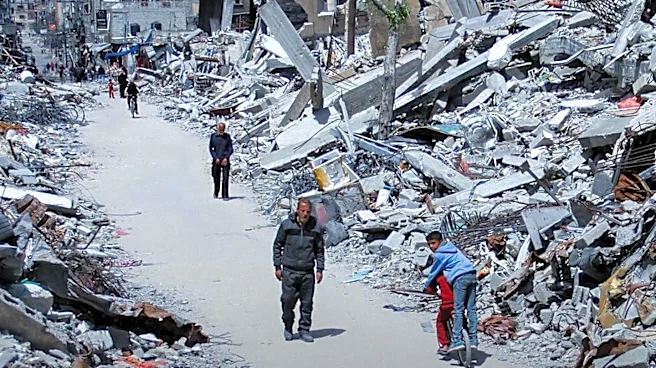
A new peer-reviewed study by Edieal Pinker of Yale School of Management, titled 'How The New York Times Framed the War Between Israel and Hamas,' found that The New York Times' reporting after October 7 consistently portrayed Palestinians as 'passive
victims' and Israel as the 'sole aggressor.' The study, published in the academic journal Studies in Conflict & Terrorism, analyzed 1,559 news articles between October 7, 2023, and June 7, 2024. Pinker concluded that approximately 70% of these articles fit a 'dominant narrative' that assigned 'near-exclusive agency and responsibility to Israel while diminishing Hamas’s role in sustaining the conflict.' The study noted that Israeli violence was almost always mentioned, while the Hamas attack itself was often omitted. For instance, there were only 38 cases where Israeli violence was absent, compared to 237 where the Hamas attack was not mentioned. The study also highlighted that mentions of Israeli casualties, including soldiers, were frequently absent, and only 42% of the articles mentioned Israeli hostages.
Why It's Important?
This study is important because it raises questions about media framing and its potential influence on public opinion regarding the Israel-Hamas conflict in the U.S. The New York Times is a prominent news organization, and its portrayal of international conflicts can significantly shape American understanding and discourse. If the reporting consistently presents one side as the 'sole aggressor' and the other as 'passive victims,' it could lead to a skewed perception of the conflict's complexities and responsibilities. This framing might impact U.S. public policy debates, humanitarian aid efforts, and diplomatic approaches to the region. The study suggests that such a narrative could diminish Hamas's responsibility and create a hierarchy of human life, potentially affecting how Americans view the suffering and losses of both Israelis and Palestinians. The findings could also fuel discussions about media bias and the challenges of objective reporting in highly sensitive geopolitical situations.
What's Next?
The New York Times previously stated that it has 'covered this war with more rigor than virtually any other US news organization, reporting on the conflict from all angles,' and that it remains 'open to good-faith disagreement but will not change our coverage to buttress entrenched perspectives.' It is likely that this study will prompt further discussion and scrutiny of media coverage of the Israel-Hamas conflict, both within academic circles and among the general public. Other media organizations may review their own reporting practices in light of these findings. The study could also influence future research into media bias and framing in conflict zones. Readers of The New York Times and other news outlets may become more critical consumers of news, seeking out diverse sources to gain a more comprehensive understanding of the conflict.
Beyond the Headlines
The deeper implications of this study extend to the broader role of media in shaping public perception and potentially influencing international relations. The consistent framing identified by the study could contribute to a polarized understanding of the conflict, making it more challenging to foster constructive dialogue or find common ground for resolution. Ethically, the study prompts questions about journalistic responsibility in presenting a balanced narrative, especially in conflicts with significant human cost. The absence of certain details, such as Israeli casualties or Hamas's actions, could inadvertently dehumanize one side or minimize their suffering in the eyes of the audience. This could have long-term cultural and societal impacts, influencing how future generations understand historical events and the role of various actors in global conflicts. The study highlights the profound power of media narratives and the need for critical engagement with news sources.