






What's Happening?
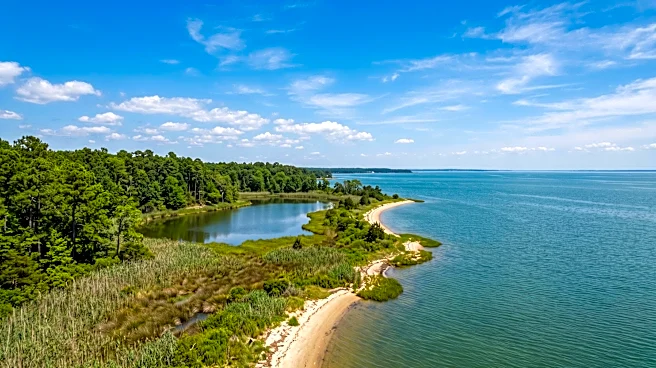
The Maryland Park Service has opened Holly Beach Farm Natural Resources Management Area, a new 293-acre waterfront park near Annapolis in Anne Arundel County. This site, formerly a dairy farm and horse breeding site, was acquired by conservation groups
in 2001 and donated to the Maryland Department of Natural Resources in 2024. Starting November 6, 2026, the park will accept online reservations for 20 guests daily, offering hiking trails, a freshwater pond, and sandy beaches. Officials have allocated millions for further upgrades, aiming to integrate it into a larger Chesapeake National Recreation Area spanning Maryland and Virginia. The park is situated on a peninsula in the shadow of the Chesapeake Bay Bridge and is designed to preserve its unique ecosystem while providing public education and recreational opportunities. A two-story home on the property, abandoned since 2001, is currently being restored into a meeting space.
Why It's Important?
The opening of Holly Beach Farm is significant for Maryland as it addresses the limited public access to the Chesapeake Bay shoreline, with 98% previously inaccessible. This new park provides valuable public access for activities such as birding, hiking, fishing, and paddling, enhancing recreational opportunities for residents and tourists. Its unique ecological feature, a freshwater pond adjacent to the saltwater bay, allows for observation of diverse wildlife dependent on both ecosystems. The park's proximity to Annapolis, Washington D.C., and Baltimore makes it an accessible natural escape, potentially boosting local tourism. The long-term vision of integrating Holly Beach Farm into a broader Chesapeake National Recreation Area underscores a commitment to large-scale environmental preservation and public engagement with natural resources across the Mid-Atlantic region.
What's Next?
Online reservations for Holly Beach Farm Natural Resources Management Area will begin on November 6, 2026, with a daily limit of 20 guests to maintain the ecological balance. Future plans include the construction of an expanded 450-foot pier to replace older structures, which will accommodate larger boats and potentially ferries, offering an alternative mode of arrival for visitors. Access to the shoreline will likely be restricted to boats and hikers, with no direct car access to minimize environmental impact. Additionally, hunting blinds are expected to be added to the shoreline for controlled hunting environments. The Maryland Park Service continues to invest in upgrades for Holly Beach Farm, viewing it as a key component of the envisioned Chesapeake National Recreation Area, which aims to expand throughout Maryland and Virginia.
Beyond the Headlines
The establishment of Holly Beach Farm highlights a growing trend in environmental conservation efforts that balance ecological preservation with public recreation. By limiting daily attendance and restricting car access, the park exemplifies a model for sustainable tourism that prioritizes the delicate balance of natural ecosystems. The integration of this park into a larger Chesapeake National Recreation Area suggests a strategic, long-term approach to regional conservation, fostering a deeper connection between the public and the Chesapeake Bay's unique environment. This initiative could serve as a blueprint for other states looking to expand public access to natural resources while ensuring their protection, potentially influencing future land acquisition and park development policies across the U.S. The restoration of the abandoned home into a meeting space also reflects a commitment to repurposing existing structures for community and educational use.