







What's Happening?
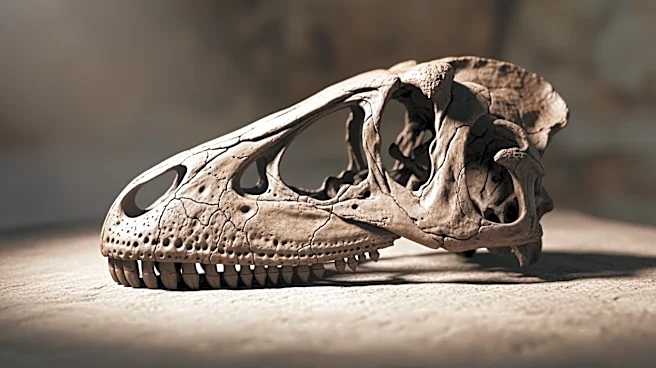
Recent research led by Christopher Griffin of Princeton University has provided compelling evidence that Nanotyrannus, previously thought to be a juvenile Tyrannosaurus rex, is indeed a separate species. The study focused on the original Nanotyrannus fossil,
particularly a small throat bone known as the ceratobranchial or hyoid, which was preserved with the skull. By analyzing the bone's growth patterns, the research team determined that the specimen had reached or was close to full maturity, indicating it was not a young T. rex. This finding supports the classification of Nanotyrannus as a distinct species, a conclusion that challenges the long-held belief that it was merely a juvenile form of T. rex. The research, involving the University of Nebraska State Museum's Ashley Poust, was published in Science and marks a significant development in paleontology.
Why It's Important?
The confirmation of Nanotyrannus as a distinct species has significant implications for understanding prehistoric ecosystems. If both Nanotyrannus and T. rex coexisted, it suggests that multiple large predators shared the same environment, which could reshape current theories about dinosaur ecology and extinction patterns. This discovery also highlights the importance of using innovative methods, such as bone histology, to study fossilized remains, potentially opening new avenues for paleontological research. The findings contribute to a more nuanced understanding of dinosaur biodiversity and the complexity of ancient ecosystems, offering insights into how species evolved and interacted over time.
What's Next?
With the debate over Nanotyrannus's classification seemingly resolved, researchers may now focus on exploring the ecological dynamics between Nanotyrannus and T. rex. Further studies could investigate how these predators coexisted and what factors allowed them to thrive in the same habitats. Additionally, the methodology used in this research could be applied to other fossil specimens, potentially leading to new discoveries about dinosaur growth and development. As paleontologists continue to uncover and analyze fossils, the understanding of dinosaur ecosystems and their evolutionary history is likely to expand.
Beyond the Headlines
The resolution of the Nanotyrannus debate underscores the evolving nature of scientific inquiry and the importance of revisiting established theories with new evidence. This case exemplifies how advancements in technology and methodology can challenge long-standing assumptions and lead to breakthroughs in understanding the natural world. The study also highlights the collaborative nature of scientific research, involving multiple institutions and experts to achieve a comprehensive analysis. As paleontology continues to evolve, such interdisciplinary approaches will be crucial in uncovering the mysteries of Earth's ancient past.