




What's Happening?
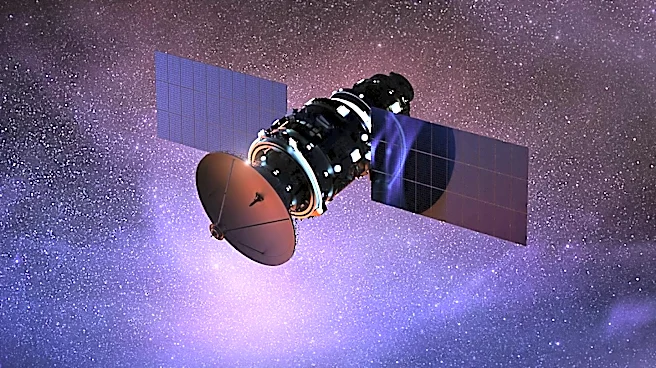
NASA has announced that the Pandora mission has commenced its observations, utilizing technology supplied by RTX. The Pandora spacecraft, integrated and tested at Blue Canyon in Lafayette, Colorado, is designed to differentiate signals from exoplanet
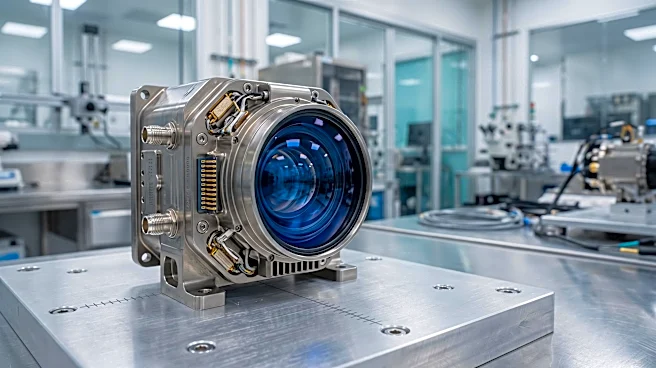
atmospheres from changes in their host stars. The mission, which completed its environmental campaign in 2025, combines a 45-centimeter diameter telescope with visible and infrared light observations. This setup allows the science team to separate the contributions of the star and its transiting planet to the measured spectrum. Blue Canyon's platform is crucial for supporting the extended pointing and operational requirements of the observing program. Lawrence Livermore National Laboratory provided project management and engineering, while NASA centers and universities contributed scientific and technical capabilities, linking industrial suppliers with scientific institutions.
Why It's Important?
The Pandora mission represents a significant advancement in exoplanet research, offering a novel approach to studying exoplanet atmospheres. By distinguishing between stellar and planetary signals, scientists can gain more accurate insights into the composition and characteristics of distant worlds, which is crucial for understanding planetary formation and the potential for life beyond Earth. For the U.S. space industry, RTX's involvement through Blue Canyon highlights the critical role of private sector innovation in supporting complex scientific endeavors. This mission not only pushes the boundaries of astronomical discovery but also demonstrates the robust capabilities of U.S. aerospace companies in developing and integrating advanced spacecraft technologies. The success of Pandora could lead to further investments in similar public-private partnerships, fostering growth and technological development within the U.S. space sector.
What's Next?
The Pandora mission is scheduled to observe at least 20 exoplanets, with each target studied on 10 separate occasions. Each observation will last 24 hours and include a transit, allowing for comprehensive data collection before, during, and after the planet's passage. This extended observation strategy aims to provide measurements at various points in the star's activity cycle. The data collected by Pandora will be analyzed by the scientific team, including contributions from Lawrence Livermore National Laboratory, NASA centers, and universities, to refine our understanding of exoplanet atmospheres. Future findings from the Pandora mission are expected to be published, contributing to the broader field of astrophysics and potentially guiding the design of future exoplanet-hunting missions.
Beyond the Headlines
The Pandora mission's innovative approach to exoplanet observation has profound implications beyond immediate scientific discovery. By enabling a clearer distinction between stellar and planetary signals, it addresses a long-standing challenge in exoplanet research, potentially unlocking new avenues for understanding the habitability of exoplanets. This mission also exemplifies the intricate collaboration between government agencies, national laboratories, universities, and private industry, showcasing a model for complex scientific undertakings. The technological advancements developed for Pandora, particularly in precision pointing and instrument integration, could have broader applications in other space missions, from Earth observation to deep-space exploration. Ultimately, Pandora contributes to humanity's enduring quest to understand its place in the universe and whether life exists beyond our solar system, fostering a sense of wonder and inspiring future generations of scientists and engineers.