



What's Happening?
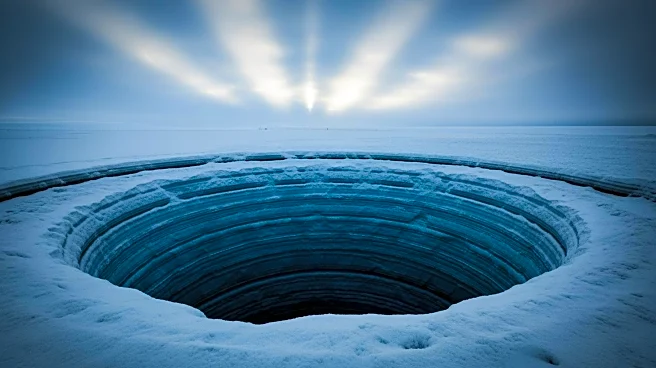
The Antarctic Gravity Hole, formally known as the Antarctic Geoid Low, is a significant gravitational anomaly located beneath Antarctica. This phenomenon is characterized by a dip in Earth's gravitational field, creating a bowl-shaped area where gravity
is slightly weaker than expected. The anomaly results in ocean water above it being about 120 meters lower than elsewhere relative to Earth's center. This gravitational feature is not caused by surface factors like winds or tides but is attributed to deep mantle rock movements and remnants of ancient tectonic plates. The anomaly has been shaped over millions of years by the sinking of dense, cold oceanic crust slabs into the mantle, which has caused a redistribution of mass within the planet. This process has been studied using seismic tomography and computer modeling, revealing the complex dynamics of Earth's interior.
Why It's Important?
Understanding the Antarctic Gravity Hole is crucial for geophysicists as it provides insights into the Earth's deep interior processes. The anomaly's existence highlights the dynamic nature of Earth's mantle and its influence on surface phenomena, such as sea level variations and ice sheet dynamics. The study of this gravitational feature can improve predictions about how changes in Earth's interior might affect global sea levels and climate patterns. Additionally, it underscores the interconnectedness of deep-Earth processes and surface climate, suggesting that even minor changes in gravity can impact the growth or retreat of ice sheets over geological time. This research contributes to a broader understanding of Earth's geological history and its ongoing evolution.
What's Next?
Future research will likely focus on further unraveling the connections between deep-Earth processes and surface climate changes. Scientists may continue to use advanced modeling techniques to predict how mantle convection patterns might evolve and influence ocean and ice sheet dynamics. Understanding these processes could lead to more accurate forecasts of sea level changes and climate shifts. Additionally, ongoing studies may explore the persistence of the Antarctic Gravity Hole and its implications for Earth's geological stability. As research progresses, it may also inform strategies for mitigating the impacts of climate change by providing a deeper understanding of the planet's internal mechanisms.
Beyond the Headlines
The Antarctic Gravity Hole serves as a reminder of the Earth's dynamic nature, challenging the perception of the planet as a static entity. The study of this anomaly highlights the importance of considering deep-Earth processes in climate models and environmental policies. It also raises questions about the long-term stability of Earth's geological features and their potential impact on human societies. As scientists continue to explore these hidden aspects of our planet, they may uncover new insights into the complex interactions between Earth's interior and its surface environment.