
What's Happening?
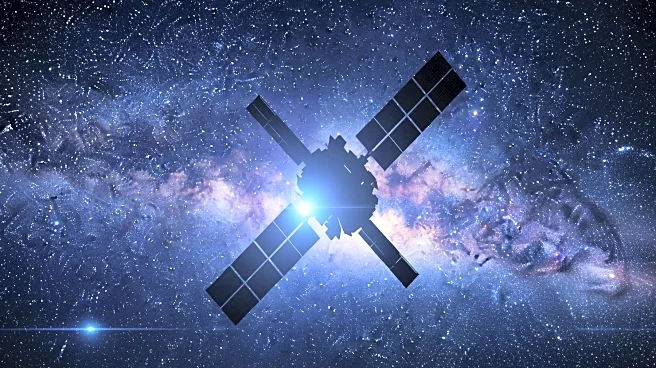
The European Space Agency's Gaia mission, operational from 2013 to 2025, has concluded after successfully mapping 2 billion stars and making 3 trillion observations. Launched in December 2013, Gaia was
designed to create the most accurate kinematic and astrometric catalog of the Milky Way. The mission provided significant insights into the galaxy's structure and evolution, revealing features such as the warped disk and the Radcliffe Wave. Gaia's data also contributed to understanding ancient galactic mergers and the dynamics of neighboring dwarf galaxies. Despite the end of its operational phase, the extensive dataset continues to be a cornerstone for astrophysical research, with ongoing analysis expected to yield further discoveries.
Why It's Important?
Gaia's mission has profoundly advanced the understanding of the Milky Way, offering unprecedented precision in mapping the galaxy's stars. This data is crucial for astronomers to study the galaxy's structure, star formation, and evolution. The mission's findings have implications for understanding dark matter distribution and the dynamics of galactic mergers. The data also aids in the discovery of exoplanets and brown dwarfs, contributing to broader astrophysical research. As the data continues to be analyzed, it will likely lead to new discoveries, enhancing the scientific community's knowledge of the universe.
What's Next?
Although Gaia has ceased operations, the analysis of its data will continue for years. Future data releases are anticipated, with the next major release expected in 2026. This release will include a large exoplanet candidate catalog, potentially revolutionizing the field of exoplanet research. The ongoing analysis of Gaia's data will likely lead to further discoveries about the Milky Way and beyond, solidifying its role as a foundational resource in observational astronomy.
Beyond the Headlines
Gaia's mission highlights the importance of international collaboration in space exploration, as it involved multiple European partners. The mission's success demonstrates the potential of long-term scientific projects to yield transformative insights. Additionally, Gaia's findings challenge existing assumptions about dark matter and galactic dynamics, prompting a reevaluation of current models. The mission's legacy will continue to influence astrophysical research and inspire future space missions.