
What's Happening?
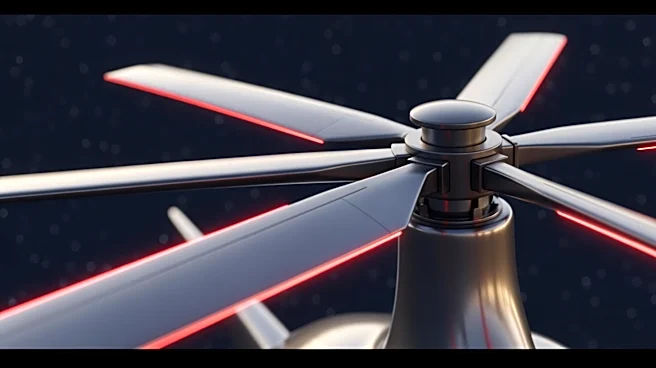
NASA has conducted successful tests on next-generation Mars helicopter rotor blades, which have demonstrated the ability to surpass the sound barrier without breaking apart. These tests were carried out at the Jet
Propulsion Laboratory's 25-Foot Space Simulator in Southern California. The testing campaign, funded by NASA's Mars Exploration Program, aims to maximize the capabilities of future aircraft designed for the Red Planet. Engineer Fernando Mier-Hicks led the inspection of the test stand used for these high-speed rotor blade tests, which are crucial for enhancing the performance and efficiency of Mars helicopters.
Why It's Important?
The ability to operate rotor blades at speeds exceeding Mach 1 is a significant advancement in aerospace technology, particularly for Mars exploration. This development could lead to more efficient and capable helicopters that can navigate the challenging Martian environment, characterized by its thin atmosphere and harsh conditions. Enhanced rotor blade performance will enable more extensive aerial surveys and data collection, contributing to a deeper understanding of Mars' surface and atmosphere. This progress supports NASA's long-term goals of exploring Mars and potentially preparing for human missions to the planet.
What's Next?
Following these successful tests, NASA will likely continue to refine and optimize the design of Mars helicopter rotor blades to ensure their reliability and effectiveness in future missions. The data collected from these tests will inform the development of new aircraft capable of conducting more complex and extended missions on Mars. As NASA prepares for upcoming Mars exploration missions, these advancements in rotor technology will play a critical role in expanding the scope and capabilities of aerial exploration on the Red Planet.