







What's Happening?
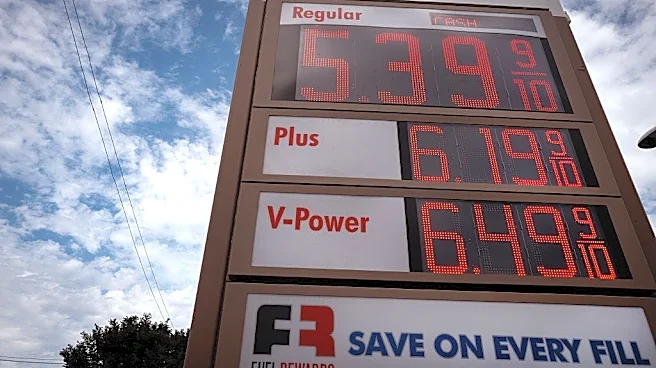
California motorists are anticipated to see a significant reduction in gas prices, with an expected drop of 10 to 30 cents per gallon next month. This relief comes as the state transitions from its more expensive summer-blend gasoline to the winter blend.
According to Patrick De Haan, head of petroleum analysis at GasBuddy, this seasonal change is the primary driver behind the projected price decrease. The announcement offers a glimmer of hope for Californians who have faced soaring prices at the pump, with the statewide average recently exceeding $6 a gallon. Prices in some Bay Area locations, such as San Jose and San Francisco, have seen increases of 20 and 21 cents, respectively, in a single week. The potential savings are a welcome development after a challenging year for drivers, during which the statewide average surged by $1.43 and diesel prices climbed to a record $8.35 per gallon.
Why It's Important?
The impending drop in California gas prices is significant for several reasons. Firstly, it provides much-needed financial relief to consumers in a state known for its high cost of living. Lower gas prices can free up household budgets, potentially stimulating spending in other sectors of the economy. Secondly, the high cost of diesel, which has soared by $3.18 over the past year, has a broader economic impact. As De Haan noted, diesel drives the U.S. economy, affecting transportation costs for goods. A reduction in fuel prices, even if primarily for gasoline, could indirectly alleviate some pressure on supply chains, potentially mitigating future price increases for everyday goods, especially during the upcoming holiday shopping season. The current high prices have been a 'brutal year at the pump' for Californians, making any relief impactful for both individual consumers and the state's economy.
What's Next?
While a price drop is anticipated by the end of October due to the winter-blend switch, gas prices could still experience fluctuations before then. Patrick De Haan of GasBuddy warned that continued escalations in the Middle East and around the Strait of Hormuz could lead to further price increases. If Houthi attacks or other geopolitical tensions intensify, the pace of price acceleration could continue. The impact of high diesel costs on retail prices is also a concern, with De Haan suggesting that businesses' current expenses will likely affect consumer prices in the next one to two months, potentially leading to 'sticker shock' by Christmas. Products requiring quick delivery, such as meat and produce, are expected to be most affected, while manufacturers of less perishable goods might absorb some costs to avoid losing sales. Motorists should monitor global events and local gas price trends as the seasonal transition unfolds.
Beyond the Headlines
The reliance on seasonal fuel blends highlights a deeper structural issue within the U.S. energy market, particularly in states like California with stringent environmental regulations. The production and distribution of specialized summer and winter blends contribute to price volatility and can exacerbate the impact of external factors like geopolitical events. While the switch to winter blend offers temporary relief, it underscores the need for long-term strategies to stabilize fuel costs and reduce dependence on volatile global oil markets. The 'brutal year at the pump' experienced by Californians also brings into focus the broader debate around energy policy, alternative fuels, and public transportation infrastructure. The ripple effect of high diesel prices on the cost of goods, potentially leading to 'sticker shock' during the holiday season, illustrates the interconnectedness of energy costs with inflation and consumer purchasing power, affecting economic stability beyond just the gas station.