



What's Happening?
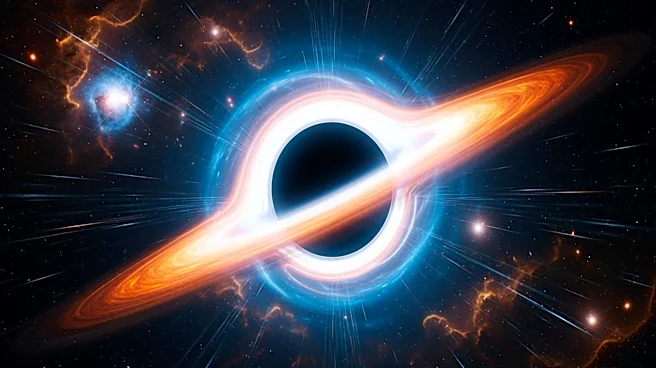
Astronomers have captured a dramatic outburst from a supermassive black hole in the galaxy J1007+3540, which had been inactive for nearly 100 million years. The black hole has restarted powerful jets that are interacting with the surrounding galaxy cluster,
causing distortion and compression due to intense pressure. Observations from the Low Frequency Array (LOFAR) and India's upgraded Giant Metrewave Radio Telescope (uGMRT) have revealed multiple cycles of activity, indicating the black hole has switched on and off over long periods. The findings, published in the Monthly Notices of the Royal Astronomical Society, highlight the episodic nature of active galactic nuclei (AGN) and the impact of the cluster's extreme conditions on the jets.
Why It's Important?
The study of J1007+3540 provides valuable insights into the behavior of black holes and their influence on galaxy evolution. Understanding how black holes switch between active and quiet states, and how jets interact with their environment, can shed light on the processes that shape galaxies over cosmic timescales. The research highlights the ongoing tension between black hole outbursts and the pressure of surrounding cosmic environments, offering clues about the dynamic nature of galaxy growth and transformation.
What's Next?
The research team plans to conduct more detailed observations using higher resolution instruments to examine the central region of J1007+3540 and track the movement of the newly restarted jets. These studies aim to deepen understanding of how black holes influence their surroundings and contribute to galaxy evolution over cosmic time.