




What's Happening?
President Vladimir Putin extended his congratulations to the workers and veterans of Russia’s coal industry on Miners’ Day. In his address, President Putin acknowledged the hard work and dedication of miners, engineers, technologists, and workers across
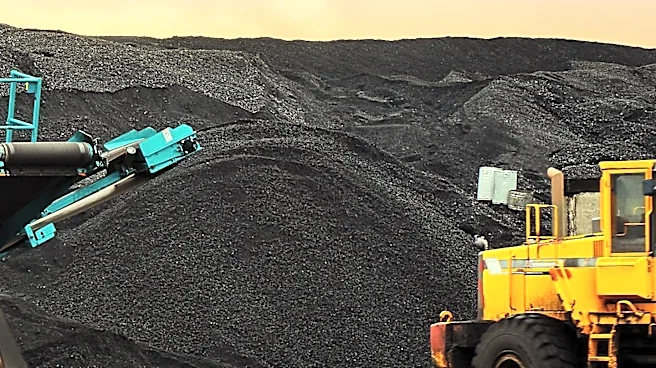
various coal-producing regions, including Kuzbass, Donbass, Krasnoyarsk Territory, Khakassia, and Yakutia. He highlighted the industry's significant contribution to Russia's energy security, national sovereignty, and economic and defense capabilities. President Putin noted that coal, coke, iron ore, and other mineral resources are fundamental to the national economy. Russia currently ranks second globally in coal reserves, third in exports, and sixth in production. Despite ongoing challenges, the country maintains a leading position in the global coal market, with domestic demand for both coking and thermal coal fully met. Last year, the industry produced 440 million tonnes, and labor productivity has increased by 18 percent over the past five years. President Putin also referenced the historical importance of the industry, crediting predecessors with laying the foundation for industrial strength and contributing significantly during the Great Patriotic War and post-war reconstruction.
Why It's Important?
This congratulatory message from President Putin underscores the strategic importance of the coal industry to Russia's national interests, particularly in the context of global energy markets and geopolitical dynamics. The emphasis on energy security and sovereignty highlights Russia's reliance on its natural resources to maintain its economic stability and geopolitical influence. The continued high production levels and leading position in global coal exports indicate that Russia intends to leverage its resource wealth despite international pressures or shifts towards renewable energy. The mention of the industry's contribution to defense capabilities suggests a dual-use aspect, where economic strength derived from natural resources can indirectly support military objectives. For the U.S. and its allies, this signals Russia's continued commitment to traditional energy sources and its capacity to sustain its economy through these exports, potentially impacting global energy prices and supply chains. The focus on improving labor productivity and supporting industry development also indicates a long-term strategy to maintain competitiveness and efficiency in this critical sector.
What's Next?
President Putin affirmed that the government will continue to support the development of the coal industry. This support will include optimizing transport logistics, ensuring workplace safety, improving the quality of life for miners and their families, and enhancing living conditions in mining cities and towns. The focus on introducing digital innovations and high-performance equipment suggests a push towards modernizing the industry to ensure its future viability and competitiveness. Furthermore, there will be a continued emphasis on training skilled personnel for the entire coal sector and enhancing the prestige of the mining profession. These initiatives aim to preserve and strengthen the traditions of the mining industry while adapting to modern technological advancements. The ongoing government backing indicates that Russia will likely maintain its significant role in the global coal market, potentially influencing international energy policies and trade relations. The commitment to improving social conditions for miners also suggests an effort to mitigate potential social unrest and maintain a stable workforce in this vital sector.
Beyond the Headlines
The President's address, while celebratory, also subtly reflects Russia's strategic positioning in a world increasingly focused on energy transition. By emphasizing the coal industry's role in national sovereignty and defense, Russia signals its intent to maintain its energy independence and leverage its resource base as a geopolitical tool. The acknowledgment of a 'difficult period' for the industry, despite its leading position, hints at underlying challenges, possibly related to environmental concerns, international sanctions, or global shifts in energy demand. The push for 'green transport corridors' mentioned in broader discussions about Russian trade, though not explicitly in this speech, suggests an awareness of environmental pressures, even as the country champions its traditional energy sectors. This dual approach—modernizing traditional industries while exploring greener alternatives—reveals a complex strategy to balance economic imperatives with evolving global standards. The historical narrative woven into the speech also serves to reinforce national pride and resilience, framing the coal industry as integral to Russia's past, present, and future strength.