
What's Happening?
NASA, in collaboration with the Universidad de Costa Rica, Chapman University, and Black Swift Technologies, is conducting the Costa Rica Airborne research on foresT Ecosystem Response to volcanic emissions
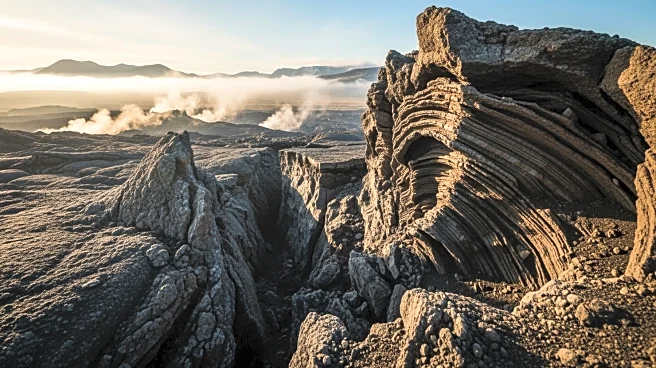
(CRATER) project. This initiative aims to study volcanic emissions and their impact on vegetation by using an uncrewed aircraft system (UAS) to gather data. The project is set in Rincón de la Vieja National Park, Costa Rica, where scientists are measuring carbon dioxide levels to understand how rising atmospheric CO2 will affect global vegetation. The project also seeks to use gas emissions as indicators of volcanic activity.
Why It's Important?
The CRATER project represents a significant interdisciplinary effort to understand the impact of volcanic emissions on ecosystems and predict volcanic activity. By studying how vegetation responds to elevated carbon dioxide levels, scientists can gain insights into future global environmental changes. Additionally, the ability to track gas emissions could improve predictions of volcanic eruptions, enhancing public safety and preparedness. This research could also contribute to broader atmospheric science by providing data on gas movement and its effects on weather patterns.
What's Next?
The CRATER project will continue to analyze data collected from the UAS and ground sensors to refine models of gas dispersion and ecosystem response. Future research may expand to other volcanic regions, providing a more comprehensive understanding of volcanic emissions and their global impact. The project's findings could inform environmental policy and conservation strategies, particularly in regions vulnerable to volcanic activity and climate change.