
What's Happening?
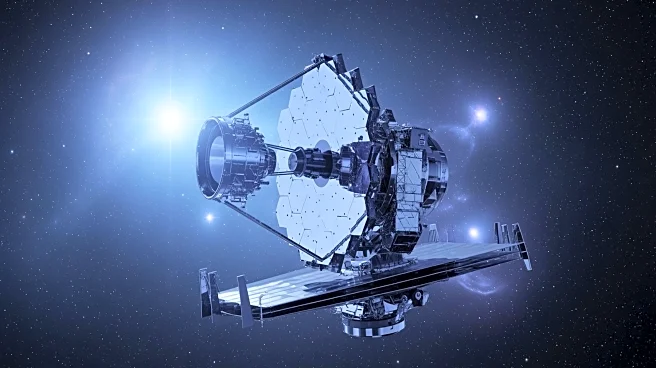
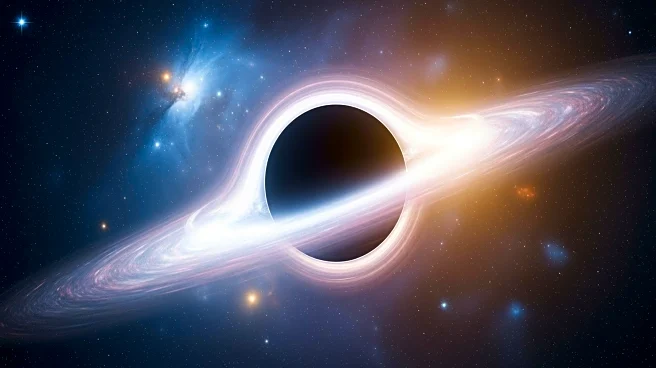
The James Webb Space Telescope (JWST) has provided the sharpest image yet of the area surrounding a supermassive black hole, potentially solving a long-standing galactic mystery. This new image, focusing on the Circinus galaxy's central supermassive black hole, reveals
that the excess infrared emissions previously observed are not from outflows of matter but from a disk of dusty material falling into the black hole. This discovery challenges previous assumptions and offers new insights into the growth and influence of supermassive black holes on their host galaxies. The JWST's advanced capabilities, including its aperture masking interferometer, have allowed astronomers to achieve this unprecedented level of detail, doubling the telescope's resolution and providing a clearer view of the black hole's environment.
Why It's Important?
This breakthrough is significant for the field of astronomy as it enhances the understanding of supermassive black holes and their role in galaxy evolution. By identifying the source of the infrared emissions, scientists can better comprehend how these massive entities grow and affect their surroundings, potentially influencing star formation. The findings also demonstrate the JWST's capabilities in providing detailed observations that were previously unattainable, marking a new era in space exploration and research. This could lead to further discoveries about the nature of black holes and their interactions with the universe, impacting theoretical models and future studies.