


What's Happening?
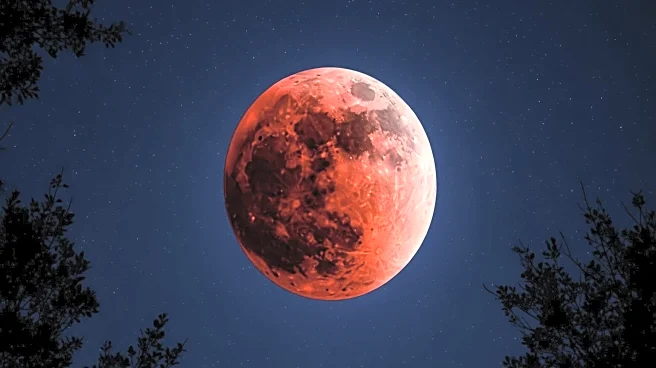
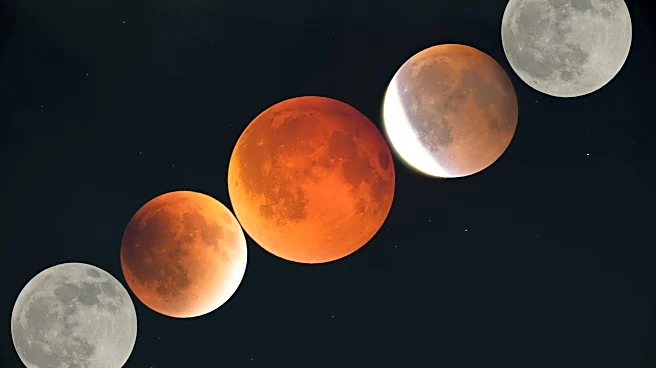
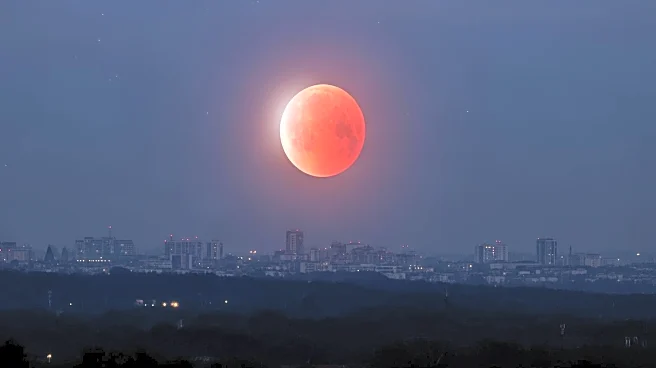
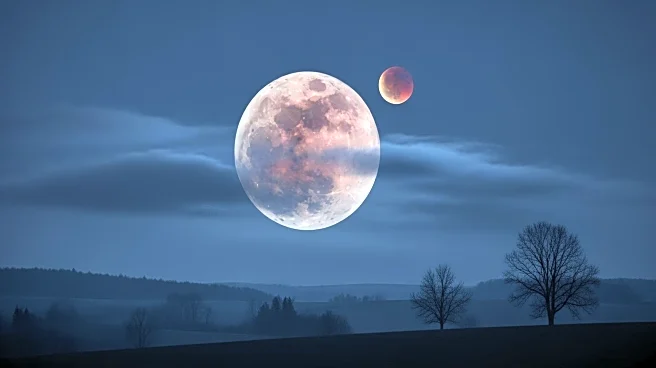
On March 3, 2026, a total lunar eclipse will occur, visible across the Americas, Asia, and Oceania. Known as a 'Blood Moon,' this event happens when the Earth aligns between the Sun and the Moon, casting a shadow that gives the Moon a red appearance.
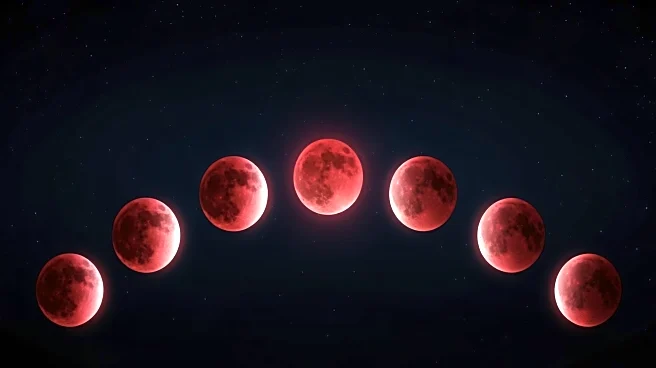
The eclipse begins with the penumbral phase at 3:44 a.m. EST, followed by the partial phase at 4:50 a.m. EST, where the Earth's shadow starts to cover the Moon. Totality, when the Moon is fully within Earth's shadow, starts at 6:04 a.m. EST and lasts for 58 minutes. The eclipse reaches its maximum at 6:33 a.m. EST, with the event concluding by 9:23 a.m. EST.
Why It's Important?
This eclipse is a significant astronomical event, as it is the last total lunar eclipse visible from the U.S. until 2028. It provides a unique opportunity for educational outreach and public engagement in astronomy. The event highlights the intricate dynamics of celestial bodies and offers a practical demonstration of orbital mechanics. For amateur astronomers and photographers, it presents a rare chance to capture the Moon's transformation. The eclipse also has cultural significance, often associated with myths and legends, adding a layer of intrigue and historical context to the scientific phenomenon.
What's Next?
As the eclipse approaches, observatories and science organizations are expected to organize viewing events and educational programs to enhance public understanding and appreciation of the event. Weather conditions will be a critical factor in visibility, and forecasts will be closely monitored. The next opportunity to witness a total lunar eclipse from the U.S. will not occur until 2028, making this event a priority for those interested in celestial phenomena. Continued advancements in technology may also provide new ways to experience and document the eclipse, potentially through virtual reality or enhanced imaging techniques.