



What's Happening?
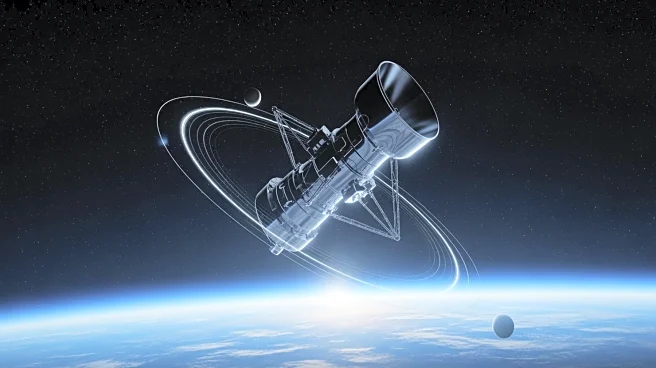
The Hubble Space Telescope, a pivotal tool in astronomical research since its launch in 1990, is facing the possibility of an earlier-than-expected reentry into Earth's atmosphere. Recent studies indicate that Hubble's orbit is deteriorating faster than anticipated,
with the telescope descending from its original altitude of 360 miles to approximately 326 miles. The Hubble Reentry Tracker has projected that, without intervention, Hubble could reenter the atmosphere as soon as 2029. This accelerated timeline is attributed to increased solar flux levels, which have heightened atmospheric drag on the telescope. NASA has previously attempted to extend Hubble's operational life through reboost missions, including a collaboration with SpaceX in 2022 to explore raising its orbit. However, no definitive plans have been announced to proceed with these efforts.
Why It's Important?
The potential loss of the Hubble Space Telescope would mark a significant gap in space-based astronomical observation. Hubble has been instrumental in numerous scientific breakthroughs, including insights into the expansion of the universe and the nature of dark energy. Its unique position in low Earth orbit allows for observations that ground-based telescopes cannot match. The absence of a direct replacement for Hubble could hinder future discoveries and limit our understanding of distant cosmic phenomena. While ground-based telescopes have advanced, they cannot fully replicate the capabilities of a space-based observatory like Hubble.
What's Next?
As Hubble's reentry looms, the scientific community is looking towards new projects to fill the impending void. One such initiative is Lazuli, a privately-funded space telescope spearheaded by former Google CEO Eric Schmidt. Scheduled for launch by 2028, Lazuli aims to offer enhanced capabilities with a larger mirror and updated instruments. While it will not be an exact replacement for Hubble, Lazuli's advanced technology could provide a modern alternative for space observation. The development and successful deployment of Lazuli could ensure continuity in space-based astronomical research, mitigating the impact of Hubble's eventual retirement.
Beyond the Headlines
The potential end of Hubble raises broader questions about the sustainability and future of space exploration infrastructure. As technological advancements continue, the role of private funding and innovation in space research becomes increasingly significant. Projects like Lazuli highlight a shift towards private sector involvement in what has traditionally been a government-dominated field. This transition could lead to new models of collaboration and funding for future space missions, potentially accelerating the pace of discovery and innovation in astronomy.