




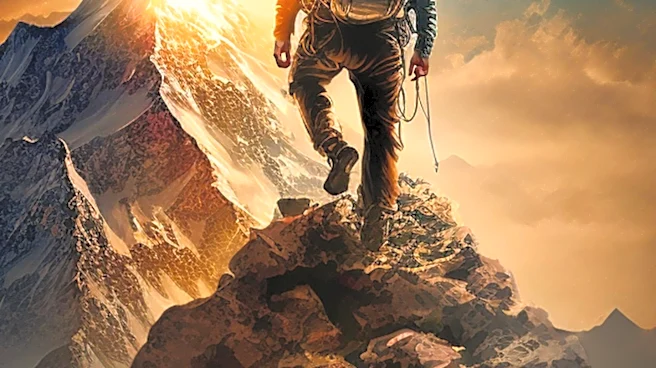
What's Happening?
The phrase 'the long walk' has been widely adopted as a metaphor for significant and arduous struggles, evolving from its original use to represent various forms of liberation and justice. Nelson Mandela's autobiography, 'Long Walk to Freedom,' is a prominent
example, symbolizing his decades-long fight against apartheid in South Africa. This powerful metaphor was later adapted by Bob Geldof for his 'Long Walk to Justice' campaign, which aimed to address extreme poverty and advocate for policy changes by G8 countries concerning Africa. The concept of a 'long walk' also appears in other cultural contexts, including a Stephen King adaptation and a song by Marcus Dalrymple, highlighting its versatility in describing prolonged and challenging journeys. The underlying sentiment often conveys perseverance through adversity, drawing parallels to spiritual texts like Psalm 23:4, which speaks of walking 'through the valley of the shadow of death' without fear.
Why It's Important?
The widespread use and adaptation of 'the long walk' metaphor underscore its profound resonance in conveying the human experience of enduring struggle and the pursuit of significant goals. For U.S. society, this metaphor reflects a shared understanding of the effort required to achieve social, political, or personal change. It highlights the universal nature of overcoming obstacles, whether in the context of civil rights movements, humanitarian efforts, or individual challenges. The appropriation of Mandela's 'Long Walk to Freedom' by figures like Geldof demonstrates how powerful narratives can transcend their original context to inspire broader movements for justice and equality, influencing public discourse and advocacy. This metaphorical framework helps to frame complex issues in a way that emphasizes resilience and the long-term commitment needed to effect meaningful transformation.
What's Next?
The continued relevance of 'the long walk' metaphor suggests its ongoing application in contemporary discussions about social and political challenges. As new movements and struggles emerge, it is likely that this phrase, or variations of it, will be invoked to articulate the arduous paths toward desired outcomes. For instance, current protests in India, led by Gen-Z, against corruption in the education system, have echoed Nehruvian and Gandhian principles of truth, fearlessness, and public action, drawing parallels to the 'long walk' concept. These movements emphasize peaceful resistance and solidarity, suggesting that the spirit of enduring a 'long walk' for justice remains a potent force. Future advocacy efforts, both domestically and internationally, may continue to leverage this metaphor to rally support and articulate the sustained effort required for systemic change.
Beyond the Headlines
Beyond its immediate political and social applications, the 'long walk' metaphor delves into deeper psychological and philosophical dimensions of human endurance. It speaks to the ethical imperative of perseverance in the face of injustice, echoing Gandhi's concept of 'satyagraha'—holding firmly to truth and justice, even when it entails suffering. This perspective suggests that true courage lies not in the absence of fear, but in the unwavering commitment to what is right, believing that truth ultimately prevails. The metaphor also highlights the intergenerational transmission of ideas and struggles, as seen in Nehru's influence on Mandela and subsequent movements. It underscores the idea that progress is often a cumulative effort, built upon the 'long walks' of those who came before, and that each generation contributes to an ongoing journey toward a more just world.