



What's Happening?
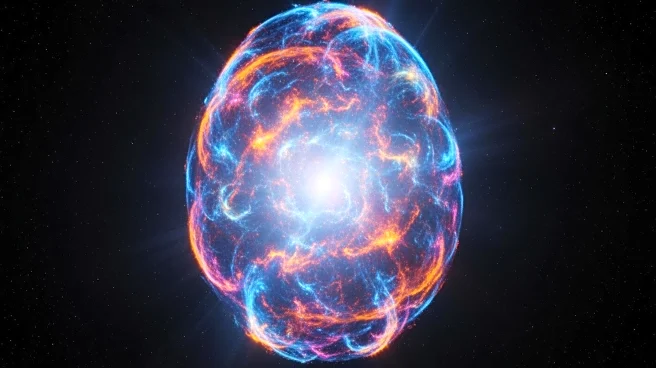
NASA's Hubble Space Telescope has captured a detailed image of the Egg Nebula, located approximately 1,000 light-years away in the constellation Cygnus. This nebula, named for its egg-like appearance, features a central star surrounded by a dense cloud
of dust, resembling a yolk within an egg white. The Egg Nebula is classified as a pre-planetary nebula, an early stage in the evolution of a planetary nebula, which is a glowing shell of gas and dust shed from a dying sun-like star. This particular nebula is noted for being the first, youngest, and closest pre-planetary nebula ever discovered, providing scientists with a unique opportunity to study the late stages of stellar evolution. The symmetrical patterns observed in the nebula suggest a series of coordinated sputtering events in the carbon-enriched core of the dying star, rather than a violent supernova explosion.
Why It's Important?
The detailed observations of the Egg Nebula by the Hubble Space Telescope are significant for understanding stellar evolution, particularly the processes that occur in the late stages of a star's life. As the pre-planetary stage lasts only a few thousand years, the Egg Nebula offers scientists a rare chance to observe the ejection process in real time. This stage is crucial as it provides the seed material for future star systems, potentially leading to the formation of planets. The insights gained from studying the Egg Nebula can enhance our understanding of how stars like our Sun evolve and eventually contribute to the cosmic cycle of matter. This research could have broader implications for astrophysics, particularly in understanding the lifecycle of stars and the formation of planetary systems.
What's Next?
Further study of the Egg Nebula is anticipated as scientists aim to understand the poorly understood sputtering events in the star's core. By combining past and recent observations, researchers are assembling a detailed portrait of the nebula's structure, which could offer new clues about how dying stars sculpt the material that will eventually form future generations of stars and planets. Continued observation and analysis will likely focus on the processes that lead to the ionization of the surrounding gas, marking the next stage of the nebula's evolution.