



What's Happening?
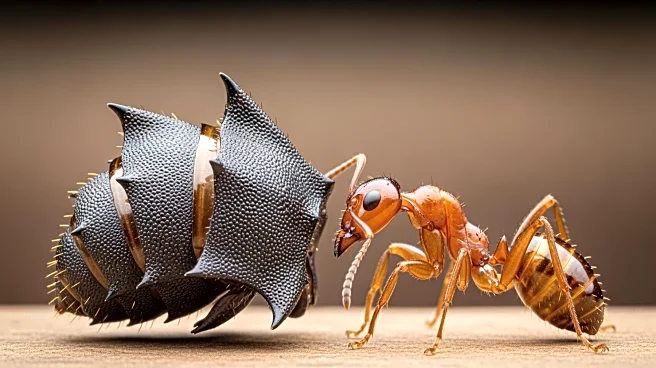
Researchers have found that as ant societies evolved, they traded individual armor for larger numbers. The study, involving a large dataset of ant species, shows that ants with less protective exoskeletons tend to form larger colonies. This trade-off
allows for more efficient resource use and has been a successful evolutionary strategy. The findings provide insights into how complex societies develop and the balance between individual and collective needs in social organisms.
Why It's Important?
The study offers a new perspective on the evolution of social insects and the dynamics of complex societies. By understanding how ants balance individual protection with collective power, researchers can gain insights into the evolution of cooperation and social complexity. This research has broader implications for understanding social evolution in other organisms, including humans, and can inform discussions on the balance between individual and collective needs in society.