




What's Happening?
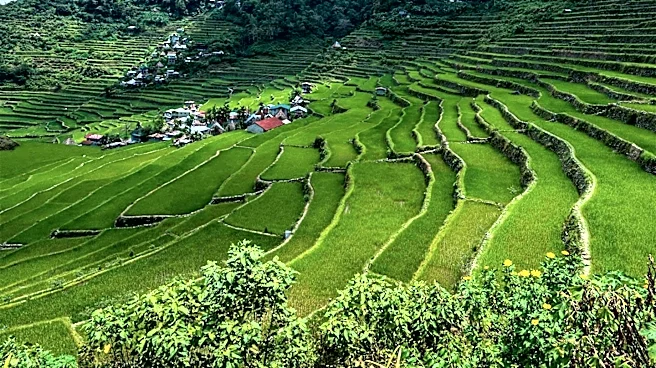
A new study by Chinese and Philippine researchers indicates that converting rainfed rice fields to irrigated farmland could significantly reduce the vulnerability of rice yields to climate change in the Philippines. The research, published in the journal
Agricultural Water Management, highlights that climate change is intensifying pressure on rice production across Southeast Asia, with extreme heat, droughts, and floods threatening food security. The Philippines' rice self-sufficiency ratio dropped to 71.7% in 2024, its lowest in decades, leading the government to declare a food security emergency on rice in February 2025. The study found that irrigated rice yields were 28% less sensitive to rising temperatures during the dry season compared to rainfed yields. For every 1°C rise in temperature, yields in irrigated areas fell by 4.0%, while in rainfed areas, they fell by 5.6%.
Why It's Important?
This research is crucial for the Philippines, a nation heavily reliant on rice for food security and livelihoods, as it faces increasing climate change impacts. The findings suggest a tangible strategy to mitigate climate-related yield losses and improve national rice self-sufficiency. The current pace of irrigation expansion is deemed insufficient to offset projected climate impacts, emphasizing the need for accelerated development. Achieving at least 60% irrigation coverage in each province could counteract negative climate effects on rice yields, potentially raising the country's rice self-sufficiency ratio to around 87% with 100% irrigation. This has significant implications for national food policy, economic stability, and the well-being of millions of farmers and consumers in the Philippines.
What's Next?
The research team plans to develop a policy advisory report based on their findings, which will be submitted to the Philippine Department of Agriculture and the National Irrigation Administration. This report aims to support future irrigation planning and policy decisions. While expanding irrigation offers substantial benefits, it also poses challenges regarding local water resources. Therefore, the Philippines will need to balance irrigation development with more efficient water management practices, such as the wider adoption of water-saving techniques like alternate wetting and drying (AWD). The study also underscores the potential for continued China-Philippines scientific cooperation in addressing climate adaptation and food security challenges in the region.
Beyond the Headlines
The study's implications extend beyond immediate agricultural policy, touching upon broader issues of international scientific collaboration and sustainable resource management. The need to balance irrigation expansion with water conservation highlights the complex trade-offs inherent in climate adaptation strategies. While increased irrigation can boost food security, it could also strain water resources, necessitating innovative approaches to water management. This research serves as a model for how scientific partnerships can provide actionable insights for countries grappling with the dual challenges of climate change and food security, potentially influencing similar strategies in other rice-producing nations in Southeast Asia and beyond.