



What's Happening?
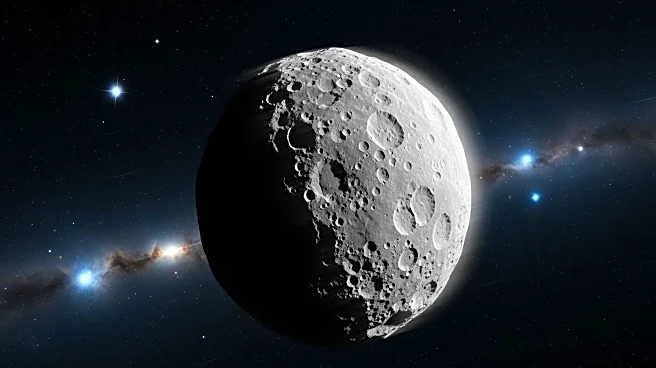
The Vera C. Rubin Observatory in Chile has identified the fastest-rotating large asteroid ever observed, named 2025 MN45. This asteroid, measuring approximately 710 meters in diameter, completes a rotation every 1.9 minutes. This discovery was made during
the observatory's initial nine nights of observations in April and May 2025. The speed of 2025 MN45 is unprecedented, as it was previously believed that asteroids of this size, typically composed of loosely held rubble piles, could not rotate faster than once every 2.2 hours without disintegrating. The findings were presented by Dmitrii Vavilov from the University of Washington at the Lunar and Planetary Science Conference in Texas. The research team identified 76 asteroids with calculable rotational periods, with 19 classified as super-fast rotators, and three, including 2025 MN45, as ultra-fast rotators.
Why It's Important?
This discovery challenges existing theories about the structural integrity and composition of large asteroids. The rapid rotation of 2025 MN45 suggests it is composed of a more solid material, possibly metal, rather than a loose collection of rocks. This finding could have significant implications for understanding asteroid formation and stability, potentially affecting future asteroid mining endeavors and planetary defense strategies. The ability to identify and study such fast-rotating asteroids could lead to new insights into the diversity and physical properties of these celestial bodies, influencing both scientific research and space exploration policies.
What's Next?
The Vera C. Rubin Observatory is set to continue its 10-year survey of the southern sky, which is expected to uncover more fast-rotating asteroids. This ongoing research will allow astronomers to further explore the diversity and characteristics of these objects, potentially leading to revisions in current astrophysical models. The findings may prompt additional studies into the composition and formation of asteroids, as well as their potential impact on Earth. The scientific community will likely focus on understanding the mechanisms that allow such rapid rotation without structural failure, which could have broader implications for space exploration and asteroid impact prevention strategies.