
What's Happening?
Recent research has uncovered that the ancient Roman city of Pompeii, famously destroyed by the eruption of Mount Vesuvius in A.D. 79, faced significant health and environmental risks due to its water
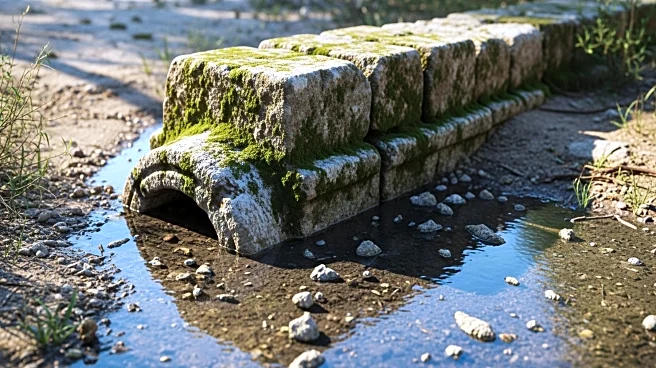
system long before the volcanic disaster. A study published in the Proceedings of the National Academy of Sciences examined carbonate deposits in Pompeii's wells, aqueducts, and public baths. These deposits, analyzed by researchers from Johannes Gutenberg University Mainz and other institutions, revealed a transition from groundwater wells to a Roman aqueduct system. Initially, Pompeii relied on wells tapping into mineral-rich volcanic groundwater, which required mechanical devices for water lifting and offered limited hygiene in public baths. The introduction of an aqueduct in the first century A.D. improved water quality and availability. However, the study found evidence of contamination from human waste and heavy metals like lead, zinc, and copper, likely from water boilers and piping. These findings provide insights into the technological and environmental challenges faced by Pompeii before its destruction.
Why It's Important?
The study of Pompeii's water system offers valuable lessons on the intersection of technology, public health, and environmental management in ancient societies. The findings highlight the potential health risks associated with early urban water systems, including contamination from human waste and heavy metals. This research underscores the importance of understanding historical water management practices to inform modern approaches to urban planning and public health. The presence of heavy metals and contamination in ancient water systems also raises questions about the long-term impacts of infrastructure on human health and the environment. Additionally, the study provides a rare glimpse into the environmental signals preserved in carbonate deposits, offering insights into volcanic activity and its influence on groundwater long before the catastrophic eruption of Mount Vesuvius.
What's Next?
The research opens avenues for further exploration into the environmental and health impacts of ancient water systems. Future studies could expand on the findings by examining other ancient cities with similar water management practices to understand the broader implications of these systems on public health and urban development. Additionally, the insights gained from Pompeii's water system could inform modern water management strategies, particularly in regions with similar geological and environmental conditions. Researchers may also continue to investigate the environmental signals preserved in carbonate deposits to better understand historical volcanic activity and its impact on ancient societies.
Beyond the Headlines
The study of Pompeii's water system not only sheds light on ancient engineering and public health challenges but also raises ethical considerations about the legacy of infrastructure on human societies. The presence of heavy metals and contamination in ancient water systems prompts reflection on the long-term consequences of technological advancements and their impact on human health and the environment. This research also highlights the importance of preserving archaeological sites and artifacts, as they provide critical insights into the past that can inform present and future decision-making. The findings from Pompeii serve as a reminder of the complex interplay between human societies and their environments, emphasizing the need for sustainable and health-conscious urban planning.