
What's Happening?
Gen. Ronald Clark, commander of U.S. Army Pacific, emphasized the strategic importance of Exercise Balikatan 2026, the largest-ever drill in the series, held in the Philippines. The exercise, which took
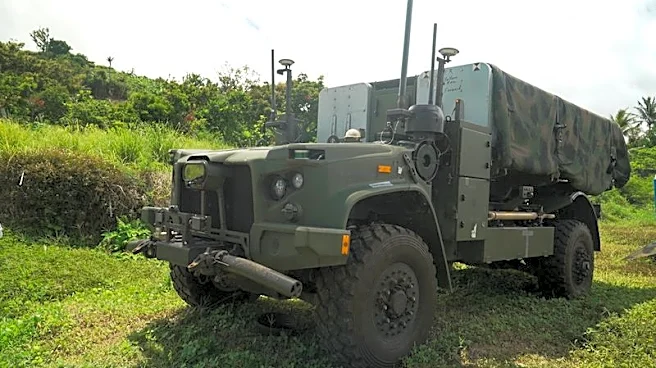
place from April 20 to May 8, involved troops from seven countries, including the United States, Australia, Canada, France, Japan, and New Zealand. This iteration marks a significant expansion, with the latter four nations participating on the ground for the first time. Clark, who has led USARPAC since November 2024, views Balikatan as a 'full-circle event,' having participated in the exercise as a young company commander in 1994. The exercise has evolved from focusing on counterinsurgency to large-scale combat operations and territorial defense, reflecting current geopolitical tensions, particularly concerning Taiwan. The U.S. military rehearsed rapid deployment of HIMARS rocket launchers and NMESIS anti-ship missile systems to remote islands, underscoring the exercise's role in preparing for potential conflicts involving the Chinese navy.
Why It's Important?
Balikatan 2026 is crucial for strengthening military alliances and enhancing readiness in the Asia-Pacific region, a strategic area given the rising tensions with China over Taiwan. The exercise allows participating nations to build trust and interoperability, which are vital for collective security. For the U.S., it demonstrates a commitment to regional stability and deterrence, reinforcing its presence and influence in the area. The involvement of multiple countries highlights the growing international concern over security in the Indo-Pacific, potentially deterring aggressive actions by adversaries. The exercise also serves as a platform for the U.S. to showcase its military capabilities and readiness to support allies in times of crisis.
What's Next?
The continuation of such exercises is likely, with potential expansions in scope and participation. The U.S. and its allies may increase the frequency and complexity of joint drills to further enhance military readiness and cooperation. The evolving focus of Balikatan suggests a shift towards preparing for high-intensity conflicts, which could influence future military strategies and defense policies in the region. Additionally, the U.S. may seek to strengthen bilateral and multilateral defense agreements with participating nations, ensuring a robust collective security framework.