









What's Happening?
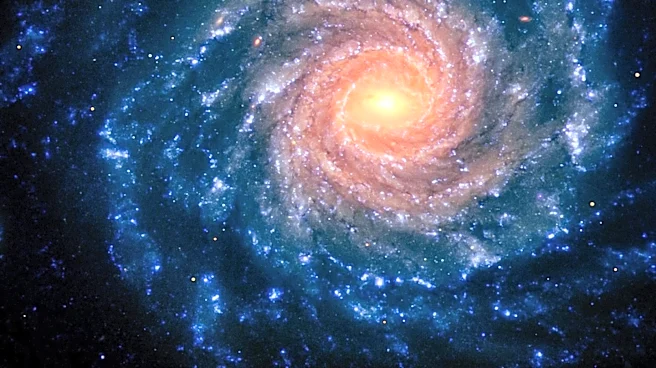
NASA's Chandra X-ray Observatory, in conjunction with the European Space Agency's XMM-Newton, has provided new insights into the structure of the Milky Way galaxy. Astronomers have discovered that the spiral arms of the Milky Way extend further into space
than previously thought. This discovery was made possible by measuring the distances of dust clouds using gamma-ray bursts, which are not affected by Earth's position within the galaxy. The study, led by Italian PhD student Beatrice Vaia, suggests that the Milky Way's spiral arms are more expansive, which could lead to revisions in the estimated mass and structure of the galaxy.
Why It's Important?
This discovery is crucial for our understanding of the Milky Way's structure and dynamics. By providing more accurate measurements of the galaxy's spiral arms, astronomers can refine models of the Milky Way's mass distribution and rotation. This has implications for understanding the galaxy's formation and evolution, as well as its gravitational interactions with neighboring galaxies. The findings could also impact the search for dark matter, as a more accurate map of the galaxy's mass distribution is essential for identifying dark matter's influence.
What's Next?
Researchers will continue to search for more gamma-ray bursts to further refine their measurements of the Milky Way's spiral arms. This ongoing research will help improve our understanding of the galaxy's structure and dynamics. Additionally, the findings may prompt revisions in existing models of the Milky Way, influencing future astronomical research and exploration. The scientific community will be closely monitoring these developments, as they could provide new insights into the nature of our galaxy and its place in the universe.