



What's Happening?
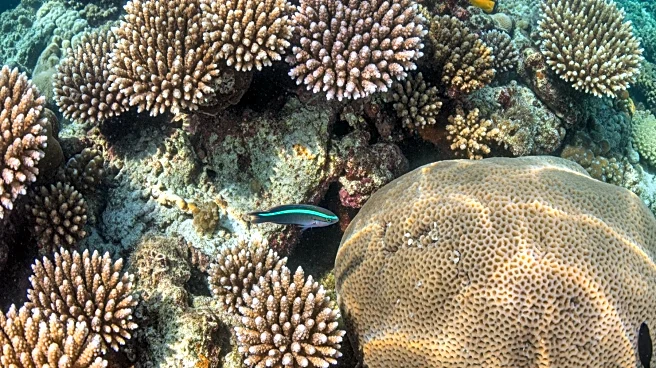
Researchers at Osaka Metropolitan University in Japan have discovered a new behavior in cleaner wrasse, a small reef fish, that suggests a higher level of cognitive processing than previously understood. During experiments involving mirrors, these fish not
only recognized their reflections but also engaged in 'contingency testing' by using shrimp as a tool to explore their mirrored environment. This behavior indicates a sophisticated level of intelligence, typically associated with marine mammals like dolphins. The study, led by Shumpei Sogawa and Masanori Kohda, involved marking the fish with artificial 'parasites' and observing their reactions to mirrors. The fish quickly learned to use their reflections to locate and attempt to remove these marks, demonstrating self-awareness. Additionally, after several days, some fish used shrimp to test the mirror's properties, a behavior that parallels actions seen in manta rays and dolphins.
Why It's Important?
This discovery challenges the traditional understanding of animal cognition and self-awareness, which has largely been limited to mammals and birds. The cleaner wrasse's ability to use tools and recognize themselves in mirrors suggests that self-awareness may be more widespread across different species than previously thought. This has significant implications for evolutionary biology, as it may require a reevaluation of the cognitive capabilities of fish and other non-mammalian species. Furthermore, these findings could influence animal welfare policies, as recognizing self-awareness in a broader range of species may lead to changes in how animals are treated in captivity and research. The study also opens new avenues for research into the evolution of intelligence and self-awareness, potentially impacting fields such as artificial intelligence and robotics.
What's Next?
The research team plans to expand their studies to include a wider range of animal species, including invertebrates, to further explore the prevalence of self-awareness across the animal kingdom. This could lead to a broader understanding of cognitive evolution and the development of self-related processing in animals. Additionally, the findings may prompt further investigations into the ethical treatment of animals in research and captivity, as well as influence the design of AI systems that mimic biological intelligence. The study's implications for evolutionary theory and animal cognition are likely to spark discussions and further research in the scientific community.
Beyond the Headlines
The study's findings could have long-term implications for how humans perceive and interact with animals, particularly in terms of ethical considerations and conservation efforts. Recognizing self-awareness in fish and other species may lead to increased efforts to protect their natural habitats and improve their living conditions in captivity. Additionally, the research may contribute to a deeper understanding of the evolutionary processes that lead to complex cognitive abilities, potentially influencing the development of new technologies that draw inspiration from biological systems.