
What's Happening?
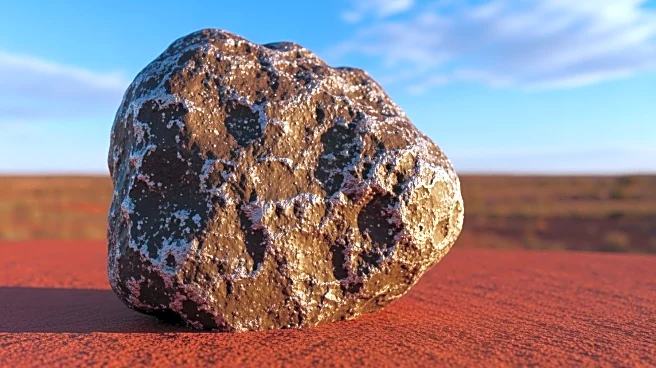
A prospector in southeastern Australia discovered a dense, rust-colored rock while searching for gold, which turned out to be a rare meteorite dating back 4.6 billion years. Known as the Maryborough meteorite,
this 17-kilogram object was found near Maryborough Regional Park and is one of the oldest meteorites discovered in the region. The meteorite, identified as an H5 ordinary chondrite, contains chondrules, which are among the earliest solid materials formed in the solar system. The discovery was made by David Hole, who initially believed the rock contained gold due to its weight and appearance. After failing to break it open, he took it to the Melbourne Museum, where geologists confirmed its extraterrestrial origin.
Why It's Important?
The Maryborough meteorite provides valuable insights into the early solar system's chemical composition and the processes that led to the formation of planets. As a natural archive, it preserves details about the birth of planets and the evolution of life-supporting environments. The meteorite's discovery highlights the potential for significant scientific findings in unexpected places and underscores the importance of careful analysis of unusual geological specimens. This find contributes to our understanding of the solar system's history and the conditions that may have led to the emergence of life on Earth.