






What's Happening?
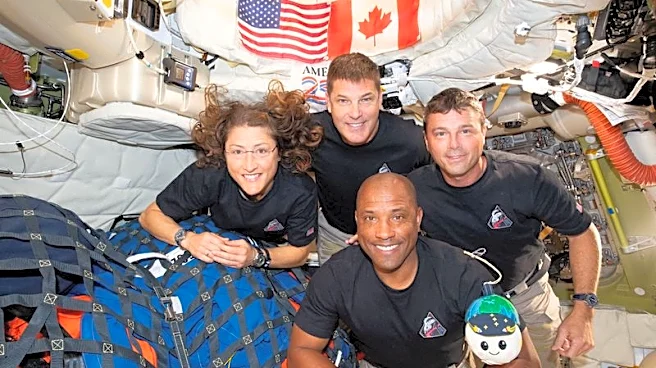
The crew of NASA's Artemis II mission has returned to Houston after completing a historic 10-day mission around the Moon. The mission, which included NASA astronauts Reid Wiseman, Victor Glover, Christina Koch, and Canadian Space Agency astronaut Jeremy
Hansen, marked the first crewed lunar flyby in over 50 years. The astronauts traveled a record distance of 252,756 miles from Earth and conducted a close approach to the lunar surface. After splashing down in the Pacific Ocean, the crew underwent medical evaluations before returning to NASA's Johnson Space Center, where they were reunited with their families and colleagues. The mission is part of NASA's Artemis program, which aims to return humans to the Moon and eventually send astronauts to Mars.
Why It's Important?
The Artemis II mission is a critical step in NASA's efforts to advance human space exploration and maintain the United States' leadership in space. By successfully completing the mission, NASA has demonstrated the capabilities of the Orion spacecraft to safely transport astronauts beyond low-Earth orbit. This achievement supports the agency's long-term goals of establishing a sustainable human presence on the Moon and exploring Mars. The mission also highlights international collaboration, with Canadian astronaut Jeremy Hansen participating in the mission. The success of Artemis II could lead to technological advancements and inspire future generations to pursue careers in science and engineering.
What's Next?
Following the successful return of the Artemis II crew, NASA will focus on preparing for future Artemis missions, including the planned lunar landing in 2028. The agency will continue to develop and test the necessary technology, such as lunar landers and spacesuits, to ensure readiness for upcoming missions. NASA will also conduct post-mission evaluations and debriefs to gather insights from the Artemis II mission, which will inform the planning and execution of future missions. The agency's long-term goals include establishing a sustainable human presence on the Moon and eventually sending astronauts to Mars.
Beyond the Headlines
The Artemis II mission underscores the importance of human involvement in space exploration, despite the capabilities of orbiters and rovers. NASA emphasizes that exploration is part of human DNA and that astronauts play a crucial role in advancing scientific discovery. The mission also highlights the risks associated with space travel, as astronauts face challenges during their journey and return to Earth. The success of the Artemis program could lead to increased investment in space exploration and inspire international cooperation in the pursuit of scientific discovery.