





What's Happening?
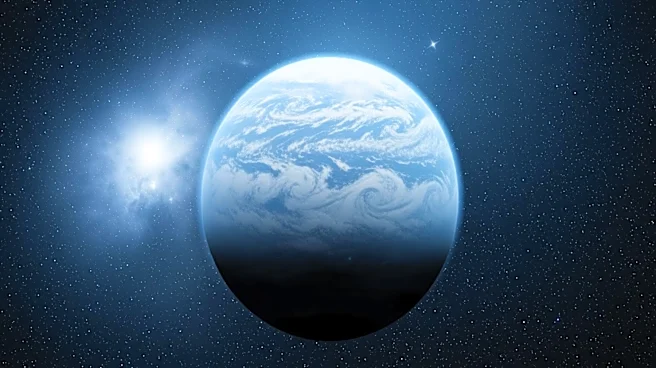
Astronomers have identified thick water-ice clouds on the exoplanet Epsilon Indi Ab, a Jupiter-like planet orbiting a nearby star. This discovery was made using the James Webb Space Telescope (JWST), which provided detailed atmospheric data. Epsilon Indi Ab is a cold,
massive planet with temperatures ranging from minus 70 to plus 20 degrees Celsius. The presence of these clouds helps explain why the planet does not conform to simpler atmospheric models. The study, led by Elisabeth Matthews from the Max Planck Institute for Astronomy, highlights the complexity of such distant worlds and the need for advanced atmospheric models. The findings suggest that the planet's atmosphere contains a thick, patchy layer of water-ice clouds, which affects its visibility and the detection of ammonia in its atmosphere.
Why It's Important?
The discovery of water-ice clouds on Epsilon Indi Ab is significant as it challenges existing atmospheric models for cold giant exoplanets. This finding underscores the limitations of current models that do not account for such cloud formations, which can obscure atmospheric features. The research has implications for future exoplanet studies, as it suggests that many cold planets may appear fainter than expected due to similar cloud cover. This could influence how astronomers plan observations and interpret data from telescopes. The study also highlights the capabilities of the JWST in providing detailed insights into distant planetary atmospheres, paving the way for more comprehensive studies of exoplanets.
What's Next?
Future observations with the JWST and other telescopes are expected to further investigate the presence of water-ice clouds on Epsilon Indi Ab and similar exoplanets. Upcoming missions, such as the Nancy Grace Roman Space Telescope, could provide more direct observations of reflective cloud layers. These studies will help refine atmospheric models and improve our understanding of exoplanetary atmospheres. The research team plans to conduct additional photometry and spectroscopy to confirm the presence of water-ice clouds and to explore the reasons behind the weak ammonia signature observed on Epsilon Indi Ab.