


What's Happening?
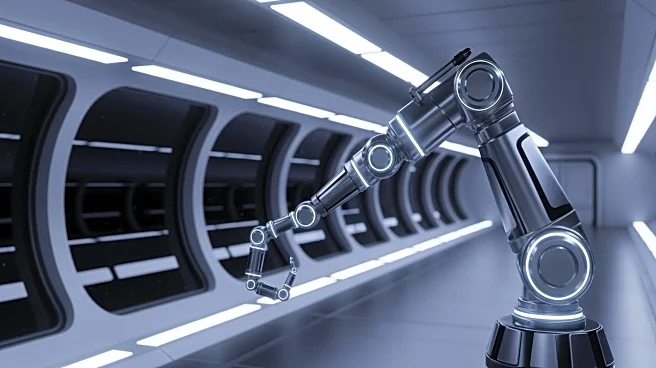
Stanford researchers have successfully used artificial intelligence to pilot a free-flying robot, Astrobee, aboard the International Space Station (ISS). This marks the first time AI has been employed to control a robot in the ISS's microgravity environment.
The AI system, developed by Stanford, enables the robot to plan safe routes through the station's complex modules more efficiently than traditional methods. This advancement addresses the challenge of navigating with limited computing power and minimal human input. The AI model was trained on thousands of pre-computed paths, allowing for faster and safer motion planning.
Why It's Important?
This development is significant for the future of space exploration, as it demonstrates the potential for AI to enhance the autonomy of robotic systems in space. By reducing the need for human intervention, AI can enable robots to perform tasks such as inspections and logistics, freeing astronauts to focus on more critical work. This capability is crucial for future missions to the moon, Mars, and beyond, where real-time human guidance may not be feasible. The successful implementation of AI in space robotics could lead to more efficient and cost-effective space missions.
What's Next?
The success of this AI-guided navigation system sets the stage for further integration of AI in space missions. Future developments may include expanding the range of tasks that robots can autonomously perform, such as scientific experiments and equipment maintenance. As AI technology continues to advance, it is likely that more sophisticated systems will be developed, enhancing the capabilities of space robotics. This could lead to a new era of exploration, where AI plays a central role in mission planning and execution.