





What's Happening?
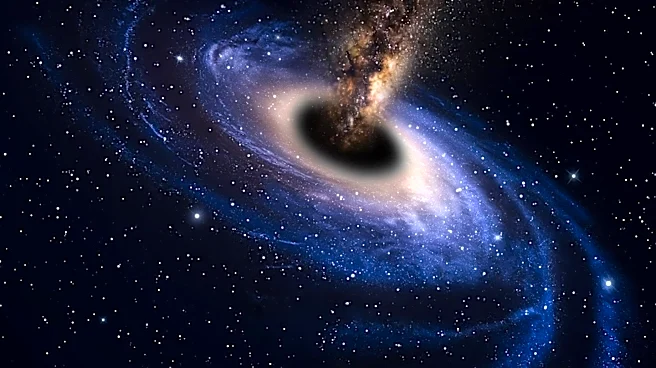
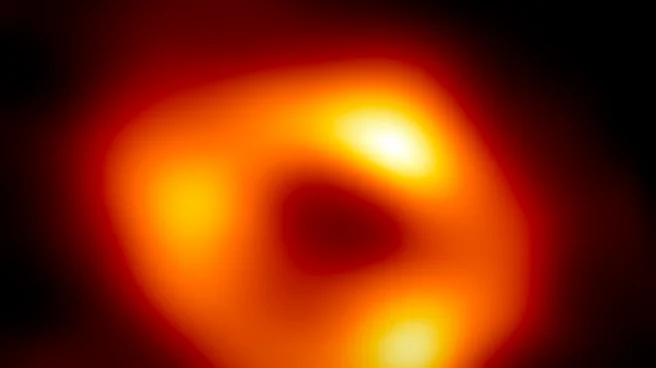
Researchers at New Mexico State University (NMSU), led by astronomy associate professor Wladimir Lyra, have found a new mechanism around supermassive black holes that suggests they can act as 'cosmic nurseries' for massive planets. Contrary to the popular
belief that black holes are cosmic vacuum cleaners, Lyra's team discovered that the outer regions of accretion disks around supermassive black holes can create conditions similar to those found around infant stars. These conditions allow for the formation of planet-mass objects made of pure dust, some of which can grow to be larger than Jupiter and even approach the mass of the sun. This research, detailed in their paper 'Active Galactic Nucleus Tori: Potential Birthplace to Millions of Planets' published in the June Astrophysical Journal, proposes a 'bottom-up' star formation mechanism, where building blocks form first and then accrete gas to create stars, a departure from the traditional 'gravitational collapse' model.
Why It's Important?
This discovery significantly alters our understanding of planet and star formation, suggesting a new pathway for celestial body creation in the universe. If supermassive black holes can indeed foster the birth of massive planets and even stars, it expands the potential locations and conditions under which life-supporting systems could emerge. The research also introduces the possibility of detecting these heavy-weight black holes, which could form from the collapse of these newly formed large stars, through gravitational wave signals by future observatories like the Laser Interferometer Space Antenna (LISA). This could provide new avenues for astronomical observation and validate Einstein's predictions about gravitational waves, opening a new window on the universe. The findings challenge existing paradigms and could lead to a re-evaluation of cosmic evolution models.
What's Next?
Lyra's team plans to further validate their theory through upcoming computer simulations, focusing on predicting electromagnetic counterparts to gravitational wave events. They aim to create a complex computer model that simulates a black hole with gas spiraling in, incorporating magnetic fields and turbulence. Additionally, the team will utilize microlensing, a phenomenon where massive objects act as cosmic magnifying glasses, to search for specific 'brightening patterns' in astronomical data. This technique, which will be significantly aided by NASA's Nancy Grace Roman Space Telescope launching in August, could provide observational evidence for their theory by detecting planets orbiting in Active Galactic Nuclei (AGN) disks as they gravitationally lens the bright AGN.
Beyond the Headlines
The NMSU research delves into the fundamental processes governing the universe, challenging long-held assumptions about black holes and cosmic evolution. The concept of black holes as 'cosmic nurseries' rather than solely destructive forces introduces a profound shift in our perception of these enigmatic objects. This work not only has implications for astrophysics but also touches upon the broader philosophical questions of where and how life might arise in the cosmos. The potential for detecting gravitational waves from these newly proposed heavy-weight black holes could usher in a new era of observational astronomy, allowing scientists to 'see' the universe in ways previously unimaginable and further test the limits of Einstein's theory of general relativity.