




What's Happening?
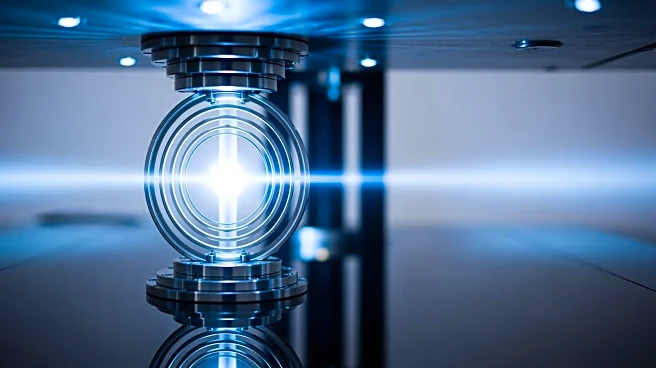
China has developed a groundbreaking hypergravity centrifuge, known as CHIEF1900, capable of generating up to 1,900 G-tons. This machine, located 49 feet beneath Zhejiang University in Hangzhou, is part of the Centrifugal Hypergravity and Interdisciplinary
Experiment Facility (CHIEF). It surpasses its predecessors, CHIEF1500 and CHIEF1300, in both capacity and capability. The centrifuge can simulate extreme gravitational forces, allowing researchers to predict the effects of natural phenomena like earthquakes and climate change. It can also test the structural integrity of models such as bridges and dams under intense G-forces. The machine's ability to compress time and distance provides insights into long-term geological processes and the biological impacts on extremophiles like tardigrades.
Why It's Important?
The CHIEF1900 centrifuge represents a significant advancement in scientific research, offering unprecedented capabilities to study and predict the effects of natural and man-made phenomena. Its ability to simulate extreme conditions can lead to better understanding and mitigation of natural disasters, such as earthquakes and climate change. This technology also opens new avenues for developing materials and alloys under high gravity, potentially leading to innovations in construction and manufacturing. The centrifuge's applications extend to environmental studies, providing models for pollutant dispersion and geological processes. As climate change becomes a pressing global issue, tools like CHIEF1900 are crucial for developing strategies to build resilience against its impacts.
What's Next?
The CHIEF1900 is expected to play a pivotal role in future scientific research, particularly in understanding climate-affected processes such as glacier dynamics, permafrost thawing, and coastal erosion. Researchers anticipate using the centrifuge to develop new materials and improve construction techniques for infrastructure resilience. The machine's capabilities will likely attract international collaboration, fostering advancements in geotechnical engineering and environmental science. As the technology matures, it may lead to the development of even more powerful centrifuges, further expanding the scope of research and innovation.