





What's Happening?
The Republican National Committee (RNC), along with the New Jersey Republican Party, Rep. Tom Kean Jr. (R-N.J.), and state Sen. Anthony Bucco, has filed a new federal lawsuit against New Jersey. The lawsuit targets Secretary of State Dale Caldwell (D)
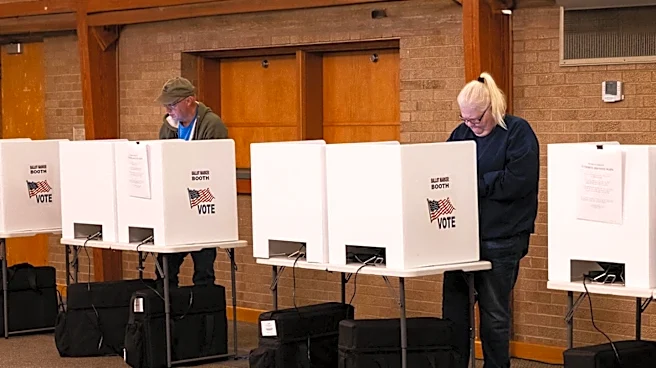
and election officials in Bergen, Middlesex, Hudson, Union, and Somerset counties. The plaintiffs are seeking a court order to compel these officials to release records detailing how the state maintains its voter rolls. This action comes just two months after a previous lawsuit filed by the RNC on similar grounds was dismissed by a judge due to a lack of standing. Essex County is not included in the current lawsuit as it has agreed to provide the requested records. The RNC's renewed efforts follow a disclosure by New Jersey's Motor Vehicle Commission that a software error erroneously registered approximately 6,600 non-U.S. citizens, with fewer than 400 of them subsequently voting. State officials have stated there is no evidence of organized voter fraud or that the error impacted election results.
Why It's Important?
This lawsuit is significant as it highlights ongoing tensions and legal battles surrounding voter roll maintenance and election integrity in the U.S. The RNC's argument that inaccurate voter rolls impair its political work and waste campaign resources underscores the perceived importance of precise voter data for political organizations. The case could set a precedent for how states are required to disclose information regarding their voter list maintenance, potentially influencing future election oversight and transparency efforts nationwide. For New Jersey, the outcome could dictate the level of public access to sensitive voter information and the administrative burden on election officials. The focus on the erroneous registration of non-citizens, despite state assurances of no widespread fraud, reflects a broader national debate on election security and the mechanisms in place to prevent ineligible voters from participating. The legal challenge also tests the boundaries of 'standing' in such cases, as the RNC has specifically detailed alleged financial and electoral harms in this new filing to address the reason for the previous dismissal.
What's Next?
The new lawsuit will proceed in federal court, where the RNC's updated allegations regarding specific financial and electoral harms will be scrutinized to determine if they establish sufficient standing. The court will assess whether the state and county officials are legally obligated to produce the requested categories of records, which include information on voters removed or placed on inactive status, communications with the Motor Vehicle Commission, and records identifying individuals removed for being non-citizens. The RNC alleges that some officials either refused to produce records, provided incomplete information, or failed to respond by a statutory deadline. The legal proceedings will likely involve arguments from both sides regarding the scope of voter data that should be publicly accessible versus privacy concerns and administrative feasibility. The outcome could lead to new mandates for voter roll transparency in New Jersey or reinforce existing practices, potentially influencing similar legal challenges in other states.
Beyond the Headlines
This legal challenge extends beyond the immediate dispute over voter records, touching upon fundamental aspects of democratic processes and public trust in elections. The RNC's persistent pursuit of these records, even after an initial dismissal, reflects a broader strategy by some political entities to emphasize election integrity concerns, particularly in the wake of past election controversies. The incident of erroneous voter registrations, while attributed to a software error by state officials, fuels narratives about potential vulnerabilities in election systems. This case could contribute to a national conversation about the balance between ensuring accurate voter rolls and protecting voter privacy, as well as the role of political parties in overseeing election administration. The involvement of the Dhillon Law Group, which also represents the Department of Justice's Civil Rights Division in a separate, appealed case seeking New Jersey voter data, suggests a coordinated effort to obtain such information, highlighting the deep political and legal implications of voter data access.