






What's Happening?
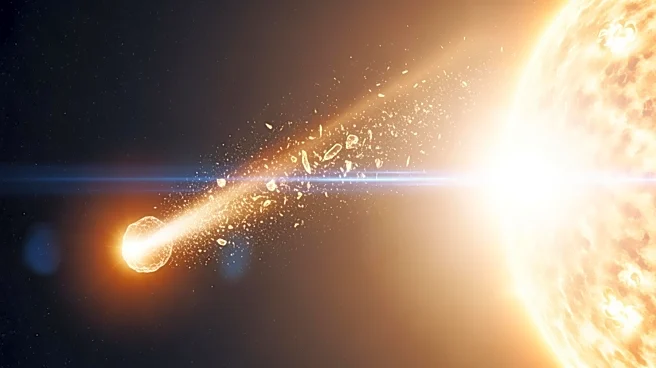
Comet MAPS, initially anticipated to be a bright spectacle in the night sky, disintegrated near the sun on April 4, 2026. As a Kreutz sungrazer, Comet MAPS came extremely close to the sun, leading to its fragmentation just hours before its closest approach,
known as perihelion. The comet's nucleus was smaller than expected, measuring only about 0.2 miles in diameter, which contributed to its inability to withstand the sun's intense heat and gravitational forces. Observations from the Solar and Heliospheric Observatory (SOHO) confirmed the comet's breakup, leaving behind a cloud of dust instead of a visible comet.
Why It's Important?
The disintegration of Comet MAPS highlights the challenges faced by sungrazing comets, which often undergo fragmentation due to the sun's extreme conditions. This event provides valuable data for astronomers studying cometary behavior and the dynamics of solar interactions. Understanding the factors that lead to comet disintegration can improve predictions about the survival and visibility of future comets. Additionally, the event underscores the importance of technological advancements in observing faint celestial objects, contributing to the broader field of cometary science.