
What's Happening?
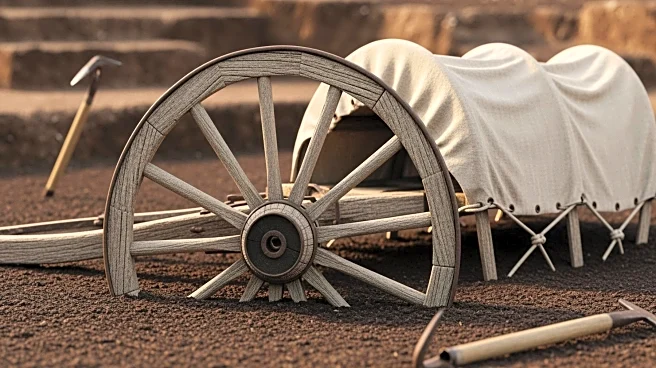
A 3,500-year-old covered wagon, known as the Lchashen wagon, has been discovered in a Bronze Age grave in Lchashen, Armenia. This wagon, made of oak, is one of the best-preserved examples of early covered wagons,
dating back to the 15th to 14th centuries B.C. The excavation revealed six oak wagons from an elite cemetery, with four featuring a complex frame structure. The Lchashen wagon, now displayed at the History Museum of Armenia, was constructed using a mortise-and-tenon system, requiring precise craftsmanship. The discovery was made in the 1950s when Soviet construction workers drained part of Lake Sevan, uncovering a Late Bronze Age cemetery with over 500 burials and numerous grave goods. The presence of wheeled vehicles in these burials highlights their significance in transporting deceased leaders to the afterlife.
Why It's Important?
The discovery of the Lchashen wagon provides significant insights into early wheeled vehicle technology and cultural practices in the Late Bronze Age. It highlights the advanced craftsmanship and engineering skills of ancient societies, as evidenced by the wagon's complex construction. This find contributes to the understanding of the development and spread of wheeled vehicles, which played a crucial role in transportation and trade. The presence of such vehicles in burial sites underscores their cultural and symbolic importance, reflecting beliefs about the afterlife. Additionally, the Lchashen wagon challenges existing theories about the origins of wheeled technology, suggesting possible influences from Mesopotamia or the Russian steppe.
What's Next?
Further research and analysis of the Lchashen wagon and similar archaeological finds could provide more clarity on the origins and evolution of wheeled vehicles. Archaeologists may continue to investigate whether this technology was independently developed in Armenia or influenced by neighboring regions. The study of burial practices and grave goods in the Lchashen necropolis could also offer deeper insights into the social and cultural dynamics of the Late Bronze Age. Ongoing excavations and technological advancements in archaeological methods may uncover additional artifacts that could reshape current understandings of ancient transportation and cultural practices.
Beyond the Headlines
The Lchashen wagon's discovery raises questions about the transmission of technological innovations across ancient civilizations. It highlights the interconnectedness of early societies and the potential for cultural exchange and adaptation. The wagon's preservation and display in a museum also emphasize the importance of protecting and studying cultural heritage, offering educational opportunities for the public to engage with ancient history. This find may inspire further interdisciplinary research, combining archaeology, history, and engineering to reconstruct and understand ancient technologies.