



What's Happening?
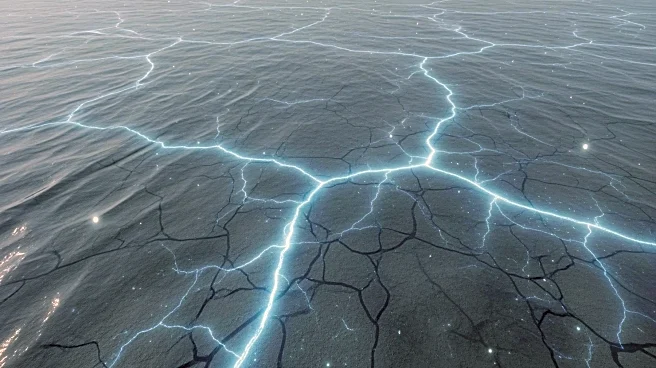
A recent study has concluded that there is little to no active faulting on the seafloor of Europa, one of Jupiter's moons. The research suggests that the seafloor is mechanically weak due to factors such as serpentinization and pre-existing fractures.
Despite these conditions, the current tidal stresses and other geological forces are insufficient to cause significant faulting. The study used models to estimate the brittle strength of Europa's lithosphere and found that the stresses required for faulting are much higher than those present. This lack of tectonic activity implies that the seafloor rocks are likely in chemical equilibrium with the ocean above, reducing the potential for sustained rock-water interactions that could support life.
Why It's Important?
The findings have significant implications for the potential habitability of Europa. On Earth, tectonic activity facilitates chemical interactions between rocks and water, creating environments that can support life. The absence of such activity on Europa suggests that its seafloor may not provide the necessary conditions for life as we know it. This challenges previous assumptions about the moon's potential to harbor life, which were based on the presence of a subsurface ocean. The study highlights the need for future missions to focus on alternative mechanisms that could support life, such as radiolysis or other chemical processes that do not rely on tectonic activity.
What's Next?
Future exploration missions, such as NASA's Europa Clipper, are expected to provide more detailed information about Europa's interior and seafloor conditions. These missions aim to measure compositional abundances in any plumes and assess the depth of the rock-water interface. Such data will be crucial in understanding the moon's geological activity and its potential for supporting life. The study suggests that direct access to Europa's ocean and seafloor may be necessary to fully assess its habitability.
Beyond the Headlines
The study also raises questions about the broader implications of tectonic inactivity on celestial bodies with subsurface oceans. It suggests that habitability assessments should consider alternative energy sources for life, such as chemical reactions driven by radiolysis. This could shift the focus of astrobiological research to include environments that do not rely on traditional tectonic processes. The findings may also influence the design of future missions to other icy moons and planets, emphasizing the need to explore diverse geological and chemical processes.