
What's Happening?
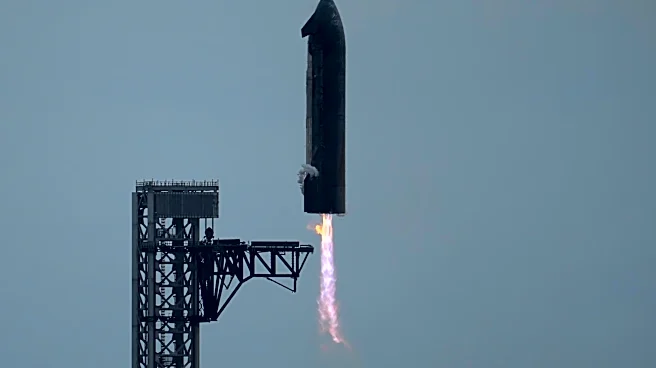
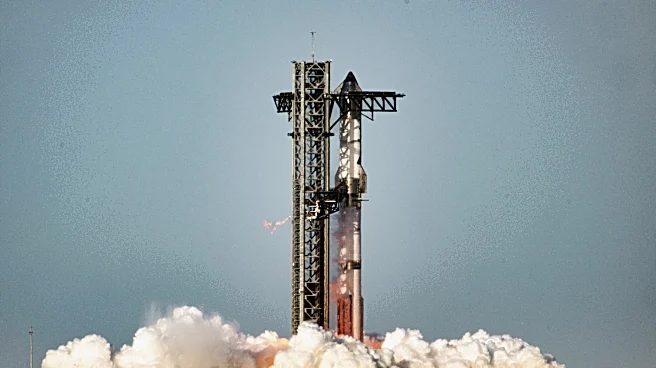
SpaceX's Starship successfully completed its first-ever orbital return and was caught by the launch pad's arms, a significant milestone for the company's reusability goals. The upper-stage Starship, after
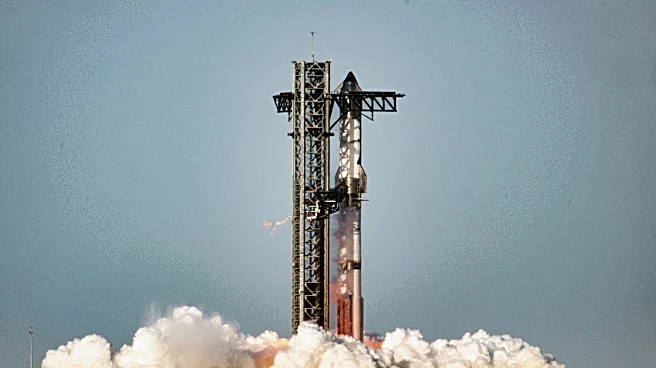
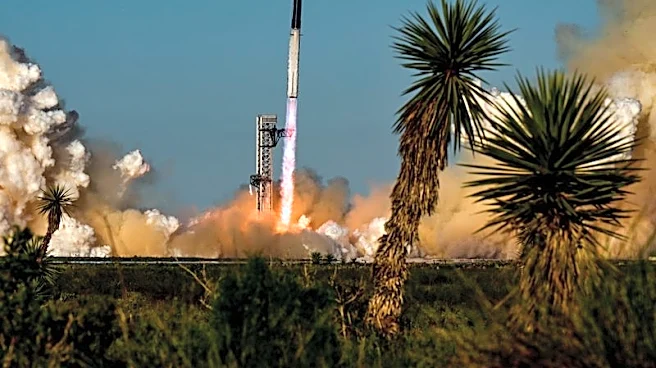
deploying 26 high-capacity 'V3' Starlink satellites and spending nearly a day in orbit, deorbited and was maneuvered into the awaiting arms of 'Mechazilla' at Starbase, Texas. This marks the first time the upper-stage of Starship has been successfully retrieved. However, the mission fell short of a 'double catch' as the first-stage 'Super Heavy' V3 booster exploded shortly after liftoff. According to SpaceX's Kate Tice, the booster's engines stopped firing too soon, causing its guidance system to initiate a watery detour and self-destruction. Engineers are currently investigating the cause of the booster's failure. Despite the booster issue, SpaceX reported that all systems on the Starship spacecraft, including its heat shield, appeared to function correctly during its 14 orbits around Earth.
Why It's Important?
The successful capture of the Starship's upper-stage is a critical step towards achieving rapid reusability in space travel, a core objective for SpaceX. This capability would allow rockets to be launched and relaunched like airplanes, significantly reducing the cost and increasing the frequency of space missions. This advancement has profound implications for the deployment of broadband and AI satellites, as well as future missions to the Moon and Mars. NASA, which is relying on Starship to land Artemis astronauts on the moon later this decade and establish a permanent lunar base, views this achievement as a major step forward. The ability to reuse the upper-stage, which is considered the more challenging half of reusability, demonstrates the viability of SpaceX's long-term vision for space exploration and commercial space operations. The failure of the booster, however, highlights the ongoing challenges in perfecting full reusability for such complex launch systems.
What's Next?
SpaceX engineers will continue to investigate the cause of the first-stage booster's engine underperformance and subsequent explosion to implement corrective actions for future launches. The company plans to inspect the recovered Starship's engines and heat shield to refine future designs, with a priority on reducing refurbishment time from weeks to days and eventually to hours. SpaceX expects to begin launching Starships from Florida's Kennedy Space Center within the next few months, which will be crucial for NASA's upcoming Artemis missions. These missions will involve lunar lander practice and eventually the docking of the Artemis capsule with Starship for lunar surface deliveries. Elon Musk has also indicated plans for a larger 'V4' version of Starship, which will be approximately 70 meters long with increased propellant capacity and more powerful engines, aiming for even more ambitious missions, including to Mars.
Beyond the Headlines
This achievement by SpaceX underscores a broader shift in the space industry towards reusability and cost-effectiveness, potentially democratizing access to space. The successful capture of the Starship's upper-stage, despite the booster's failure, demonstrates the innovative engineering and iterative development approach that characterizes the new space race. The implications extend beyond mere technological advancement; it could lead to a significant acceleration in scientific research, satellite deployment for global connectivity, and the potential for human expansion into space. The ongoing competition and collaboration between private companies like SpaceX and government agencies like NASA are reshaping the future of space exploration, pushing the boundaries of what is possible and setting new standards for efficiency and ambition in the cosmos.