
What's Happening?
The Space Foundation, in partnership with Charles County Public Schools, is bringing its 'Space in the Community' program to Waldorf, Maryland, from November 16 to 20. This initiative will feature former
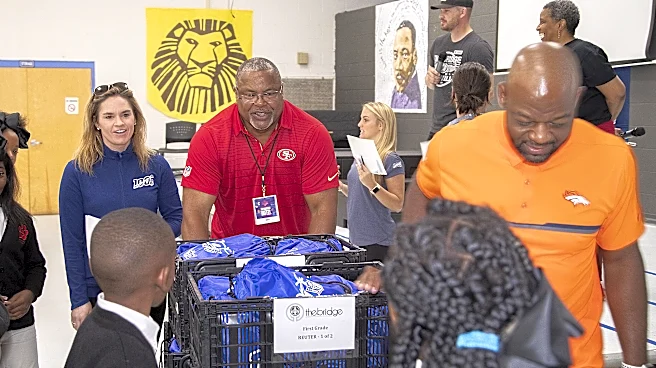
NASA astronaut Mark Polansky, a veteran of three spaceflights, who will visit middle schools across the county. The program, a nearly 20-year collaboration, aims to foster STEM learning among PreK-12 students by providing direct access to a former astronaut and hands-on, space-themed educational activities. Students will engage in an Artemis-themed activity, prioritizing and packing supplies for a lunar mission, and will explore coding and robotics using Sphero indi robots. Middle schoolers will also participate in the National Space Sustainability Competition, where they will develop sustainable orbital living solutions. A community night with Polansky is scheduled for November 20 at the James E. Richmond Science Center.
Why It's Important?
This program is significant for its role in promoting STEM education and inspiring the next generation of scientists and engineers in the U.S. By connecting students directly with a former NASA astronaut like Mark Polansky, the initiative makes complex fields like space exploration more tangible and accessible. The hands-on activities, such as the Artemis-themed lunar mission and robotics, provide practical experience that can spark long-term interest in science and technology. For Charles County Public Schools, which serves over 27,904 students, this partnership helps bridge the gap between theoretical classroom learning and real-world applications, potentially influencing career choices and contributing to a skilled workforce in critical sectors. The focus on sustainable orbital living also aligns with broader national and international efforts in space exploration and environmental responsibility.
What's Next?
The 'Space in the Community' week will run from November 16 to 20, culminating in a high school peer mentoring event and a community night presentation by Mark Polansky on Friday, November 20, at the James E. Richmond Science Center. Families in Charles County are invited to attend the community night to hear Polansky speak. The outcome of the grades 6-8 National Space Sustainability Competition, where students develop solutions for sustainable orbital living, is yet to be reported. The program's continued success could lead to further expansion or replication in other school districts, reinforcing the importance of early STEM engagement. The Space Foundation and Charles County Public Schools will likely continue to evaluate the program's impact on student interest and academic performance in STEM fields.
Beyond the Headlines
Beyond the immediate educational benefits, this program highlights a broader national strategy to maintain U.S. leadership in space and technology. By investing in early STEM education, particularly through engaging and interactive programs, the U.S. aims to cultivate a pipeline of talent essential for future innovation and competitiveness. The involvement of a former NASA astronaut underscores the value placed on experiential learning and mentorship. This initiative also subtly reinforces the narrative of space exploration as a collaborative human endeavor, with the Artemis program aiming to return humans to the Moon. Such programs can also address equity in education by making advanced scientific concepts accessible to a diverse student population, potentially opening doors to careers that might otherwise seem out of reach.